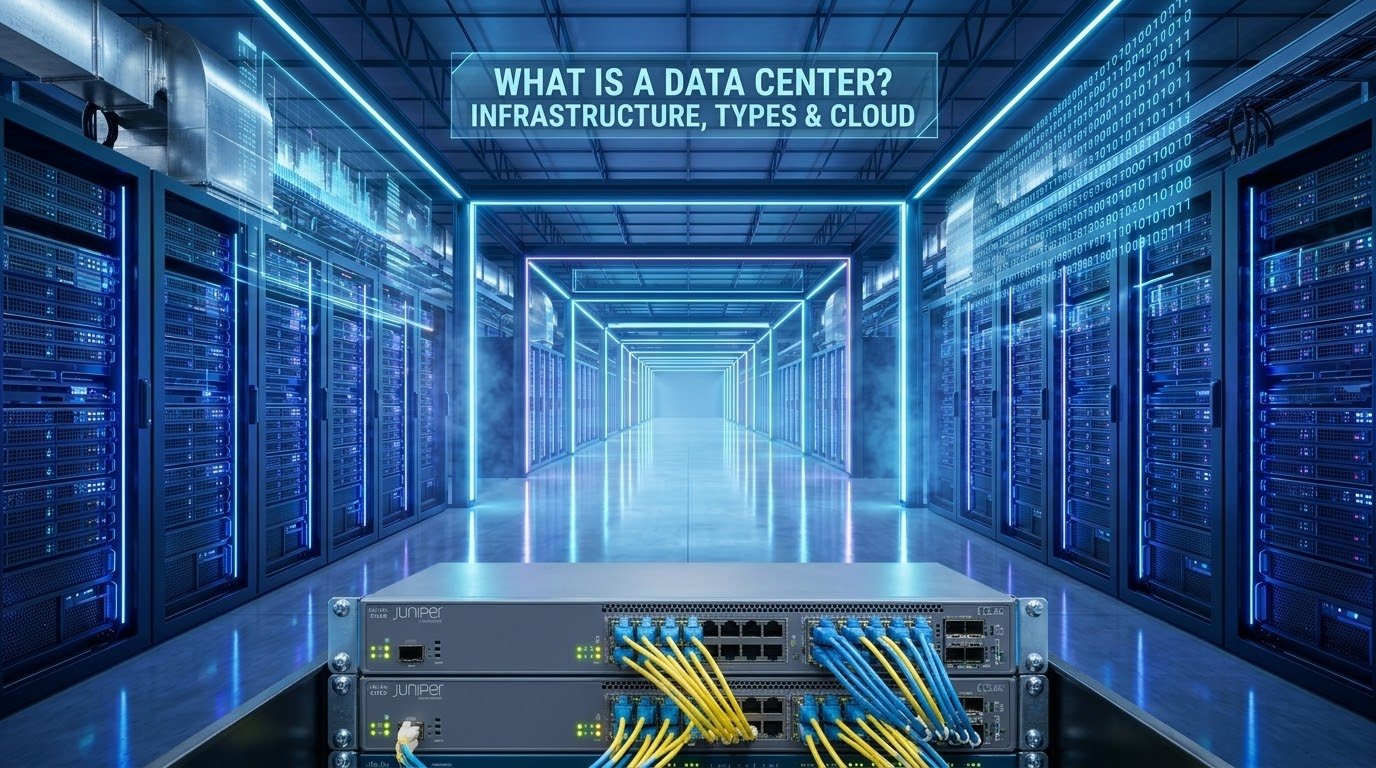
A data center is a dedicated physical facility housing centralized computing hardware, enterprise storage systems, and high-speed networking equipment. Organizations use these facilities to process, store, and distribute large volumes of digital data, relying on redundant power supplies, precision cooling systems, and strict physical security controls to maintain uninterrupted operational uptime.
Core Infrastructure of a Modern Data Center
Building and operating a facility capable of running 24 hours a day, 365 days a year requires complex mechanical, electrical, and structural engineering. Every subsystem is designed to eliminate single points of failure.
Power Distribution and Redundancy Systems
Electrical stability is the single most critical requirement for any data center. Grid power is supplemented by high-capacity Uninterruptible Power Supply (UPS) battery banks that provide instantaneous bridging power during utility voltage sags or momentary dropouts. For prolonged utility outages, banks of massive diesel generators take over within seconds, backed by bulk fuel storage contracts designed to sustain multi-day operations independently.
Thermal Management and Precision Cooling
Dense clusters of high-performance servers generate intense thermal loads that can quickly warp silicon wafers or trigger thermal throttling if unmanaged. Computer Room Air Handler (CRAH) and Computer Room Air Conditioner (CRAC) units circulate chilled air through raised flooring or containment aisles. Modern facilities increasingly deploy liquid cooling plates and closed-loop rear-door heat exchangers to handle high-density GPU racks efficiently.
Racks, Servers, and Network Switching Fabric
Hardware is housed in standardized 19-inch server racks bolted directly to concrete subfloors. Blade servers, rack-mounted compute nodes, and high-density storage arrays connect to top-of-rack (ToR) and end-of-row (EoR) switches. Optical fiber cabling and high-speed Ethernet or InfiniBand fabrics form the backbone of the internal network, ensuring low-latency data transmission across clustered nodes.
Primary Types of Data Centers
Data centers vary widely in scale, ownership model, and operational purpose depending on organizational requirements.
| Facility Type | Ownership / Operation | Primary Use Case |
|---|---|---|
| Enterprise | Single corporation | Proprietary workloads, strict internal regulatory compliance. |
| Colocation | Third-party real estate provider | Renting cage or rack space with shared power and cooling. |
| Hyperscale | Major cloud giants (AWS, Azure, GCP) | Massive distributed cloud computing and global storage infrastructure. |
| Edge | Distributed telecom or enterprise | Low-latency processing closer to end-users and IoT devices. |
Enterprise Data Centers
Enterprise data centers are privately owned and operated by single organizations—such as financial institutions, government agencies, or large universities—to house sensitive proprietary data and internal applications. While offering maximum administrative control, they demand significant capital expenditure (CapEx) and specialized internal engineering staff.
Colocation Facilities
Colocation (colo) providers lease floor space, raised racks, physical security, and mechanical infrastructure to multiple external tenants. Businesses install their own physical servers inside locked cages or dedicated server cabinets, leveraging the provider’s heavy industrial power contracts and carrier-neutral fiber connections without building a facility from scratch.
Hyperscale Data Centers
Hyperscale facilities represent massive industrial operations spanning hundreds of thousands of square feet, operated by global cloud providers like Amazon Web Services, Microsoft Azure, and Google Cloud. They consume staggering amounts of electrical power, often measured in tens or hundreds of megawatts, optimized for hyper-dense virtualization and parallel distributed computing.
Edge Data Centers
Edge data centers are smaller, highly localized facilities deployed close to population centers or specific industrial installations. By minimizing physical distance, they reduce network latency for real-time applications such as autonomous vehicle processing, content delivery networks (CDNs), and industrial IoT telemetry.
Data Centers and Cloud Computing Integration
Cloud computing has fundamentally shifted how organizations interact with physical infrastructure. Rather than investing in proprietary server rooms, businesses rent virtualized compute instances, container clusters, and managed storage repositories hosted within hyperscale data centers. However, cloud infrastructure is not entirely immaterial; every virtual machine, serverless function, and AI model query runs on physical silicon housed inside these concrete-and-steel facilities.
Frequently Asked Questions
What is the difference between a data center and cloud computing?
A data center is the physical facility containing servers, storage arrays, networking hardware, power systems, and cooling infrastructure. Cloud computing is a service model that delivers virtualized computing resources, software, and storage over the internet, utilizing physical data centers as its underlying foundation.
How much power does a modern data center consume?
Power consumption varies dramatically by scale. Enterprise server rooms may draw a few hundred kilowatts, while hyperscale data centers routinely consume between 20 to over 100 megawatts of continuous electrical power, matching the energy demands of small towns.
What does PUE mean in a data center?
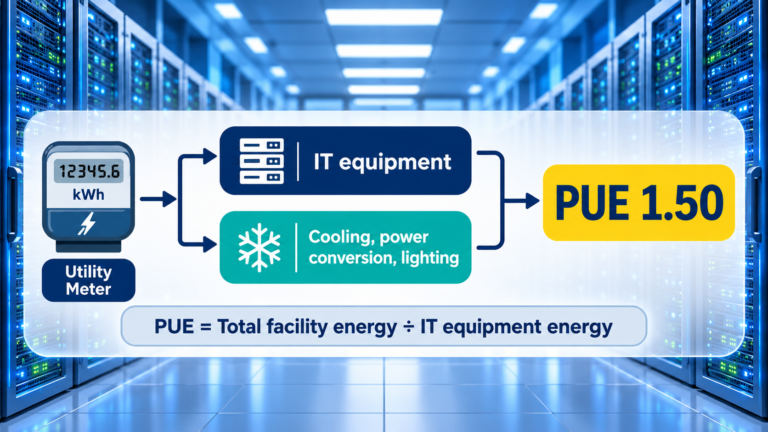
PUE stands for Power Usage Effectiveness, a standard industry metric calculated by dividing total facility energy consumption by the energy delivered directly to IT equipment. A PUE rating closer to 1.0 indicates higher facility energy efficiency.