
Data Center in Space
Data Center in Space: Technical Blueprint for Orbital Computing
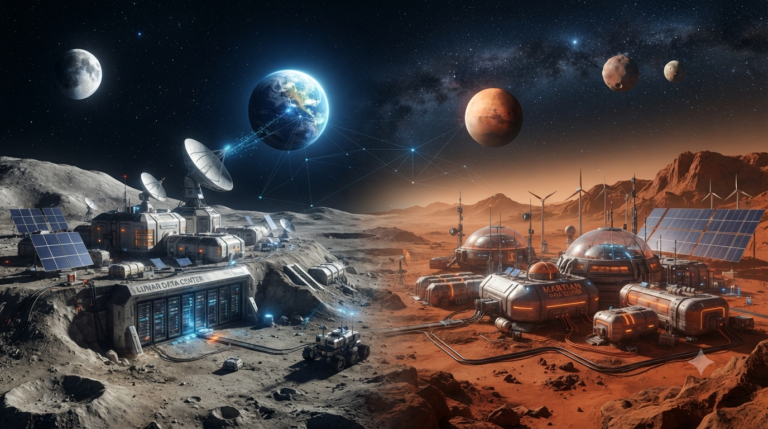
During a high-density deployment I managed several years ago, our facility hit an unyielding power and thermal ceiling during peak summer load. Our local utility capped our grid draw at 45 megawatts, and chillers struggled against a 41°C ambient heatwave. It became clear that terrestrial infrastructure is running out of thermal and geographic headroom. That operational bottleneck highlights why deploying a data center in space is no longer science fiction, but a logical step for compute architecture.
Terrestrial data centers consume vast amounts of fresh water, occupy prime real estate, and demand massive grid power. Shifting compute payloads into low Earth orbit (LEO) gives engineers access to uninterrupted solar energy and eliminates traditional ground constraints. However, running orbital compute nodes requires solving complex thermodynamic, radiative, and networking challenges.
This technical guide breaks down the engineering principles, hardware qualification standards, and latency models behind space-based computing. We analyze how orbital server clusters maintain uptime, communicate via laser interlinks, and survive harsh space environments.
Thermodynamics in a Vacuum: Solving the Space Server Cooling Challenge
On Earth, server cooling relies on convection and conduction through air or liquid loops to transfer heat into the atmosphere. In the vacuum of space, convection does not exist because there is no surrounding air medium. Every watt of heat generated by processors must be rejected entirely through thermal radiation.
Orbital facilities use closed-loop liquid cooling systems charged with specialized dielectrics or liquid metals. These loops transfer core heat away from high-density server blades to expansive exterior radiative panels. Deployable radiator arrays, coated with high-emissivity ceramic materials, face deep space to maximize heat rejection via infrared emission according to the Stefan-Boltzmann law.
Variable-conductance heat pipes (VCHPs) and loop heat pipes (LHPs) regulate coolant flow based on thermal fluctuations. When an orbital server passes through direct sunlight, solar heating spikes the hull temperature. Passive thermal louvers open and close automatically to shade sensitive electronics and direct thermal energy outward into the cold void of deep space.
Thermal Management Comparison: Terrestrial vs. Orbital
| Engineering Metric | Terrestrial Hyperscale Facility | Orbital Space Data Center |
|---|---|---|
| Primary Heat Rejection Method | Evaporative cooling, CRAH air handlers, chilled water loops | Infrared radiative cooling panels and loop heat pipes |
| Cooling Medium | Atmospheric air and municipal water supply | Vacuum radiative dissipation into deep space (3 Kelvin sink) |
| Thermal PUE Overhead | 1.10 to 1.35 overhead factor | Approaching zero parasitic cooling power in steady-state |
| Water Consumption Rate | Millions of gallons per megawatt annually | Zero gallons consumed during operation |
| Ambient Temperature Range | -10°C to +45°C ambient air | -150°C in eclipse shadow to +120°C in direct sun |
Power Architecture: Continuous Solar Harvesting in Low Earth Orbit
Power availability dictates compute density. Terrestrial facilities must negotiate utility contracts, install diesel generators, and deploy battery banks to ensure uninterrupted operation. In contrast, orbital platforms leverage photovoltaic arrays unhindered by atmospheric scattering, cloud cover, or day-night cycles when deployed in Sun-Synchronous Orbits (SSO).
High-efficiency gallium arsenide (GaAs) triple-junction solar arrays generate substantial power per square meter. These arrays feed high-voltage direct current (HVDC) bus bars operating at 100V to 300V DC. Distributing power at higher voltages reduces conductor mass and minimizes resistive I²R power losses across the satellite chassis.
During eclipse periods in standard low Earth orbits, advanced lithium iron phosphate (LiFePO4) or solid-state space-rated battery banks provide continuous power. Because solar capture in vacuum avoids atmospheric filtration, photovoltaic cells capture raw solar irradiance of approximately 1,361 W/m², vastly outperforming ground-based solar farms.
- Unfiltered Solar Spectrum: Capture full Air Mass Zero (AM0) irradiance continuously in sun-synchronous orbital paths.
- Direct DC Microgrids: Eliminate multiple AC-to-DC rectification steps common in terrestrial uninterruptible power supply (UPS) chains.
- Solid-State Power Controllers (SSPCs): Implement autonomous trip and fast-recovery switching to isolate power anomalies in microseconds.
Radiation Hardening and Silicon Reliability in Orbit
Terrestrial hardware benefits from Earth’s magnetosphere and atmosphere, which shield chips from solar particle events (SPE) and galactic cosmic rays (GCR). In orbit, high-energy protons and heavy ions penetrate structural hulls, causing transient and permanent failures in silicon devices.
Engineers manage two primary radiation threats: Total Ionizing Dose (TID) and Single Event Effects (SEE). TID causes cumulative degradation of gate oxides over years, eventually leading to leakage currents and component failure. Single Event Upsets (SEU) cause bit-flips in DRAM, while Single Event Latch-ups (SEL) create destructive short circuits across power rails.
Mitigation requires a combination of rad-hardened silicon manufacturing, error-correcting code (ECC) memory architectures, and software-level fault tolerance. Modern orbital nodes use Silicon-on-Insulator (SOI) fabrication and triple-modular redundancy (TMR), where three identical compute pipelines process instructions simultaneously, using a voting logic gate to discard corrupted bitstreams instantly.
Component Radiation Hardening Standards
| Radiation Mechanism | Physical Impact on Server Hardware | Engineering Mitigation Strategy |
|---|---|---|
| Total Ionizing Dose (TID) | Threshold voltage shifts, leakage current increase, eventual chip breakdown | Tantalum/Kevlar chassis shielding, Silicon-on-Insulator (SOI) architecture |
| Single Event Upset (SEU) | Memory bit-flips, register state changes, operational instruction crashes | Multi-bit ECC memory, Triple Modular Redundancy (TMR) voting circuits |
| Single Event Latch-Up (SEL) | High-current parasitic transistor lockup causing silicon destruction | Epitaxial substrate layers, fast-acting current-limiting power switches |
| Displacement Damage Dose (DDD) | Crystal lattice dislocation in optoelectronics and solar cell degradation | Radiation-tolerant GaAs solar cells, redundant optical transceiver channels |
High-Speed Connectivity: Free-Space Optical Inter-Satellite Links
A data center cannot function without high-bandwidth, low-latency connectivity. Traditional Radio Frequency (RF) uplinks lack the throughput needed for hyperscale data distribution and face strict spectrum allocation limits. As a result, orbital computing relies on Free-Space Optics (FSO), utilizing directed laser communication.
Laser inter-satellite links (OISLs) operate in the 1550 nm infrared band, transmitting data at rates exceeding 100 Gbps per optical transceiver. Because light travels approximately 30% to 40% faster in the vacuum of space than through terrestrial silica fiber-optic cores, long-distance orbital mesh networks can deliver lower end-to-end latency than subterranean transcontinental fiber routes.
Orbital compute platforms use fine pointing and tracking systems (PAT) with fast steering mirrors to maintain laser link alignment across thousands of kilometers at relative orbital velocities. Ground downlinks communicate directly with geographically distributed optical ground stations (OGS), routing data around local cloud cover via dynamic atmospheric switching protocols.
Edge Processing in Space: Earth Observation and On-Orbit AI
The most immediate commercial use case for space computing is direct in-orbit edge processing. Modern Earth observation, synthetic aperture radar (SAR), and hyperspectral imaging satellites generate terabytes of raw telemetry per orbit. Transmitting this uncompressed raw data to ground stations creates bandwidth bottlenecks and causes delivery delays.
By integrating AI accelerators and server blades directly into satellite constellations, operators run inference models directly in orbit. Machine learning algorithms process raw sensor data in real time, detecting anomalies such as maritime vessel movements, wildfire outbreaks, and agricultural shifts. Only the actionable insights and filtered telemetry need to be downlinked to Earth.
This edge compute architecture reduces downlink bandwidth requirements by up to 90%. Decision-makers receive critical alerts in seconds rather than waiting hours for a satellite to pass over a dedicated ground station to dump raw imagery.
Frequently Asked Questions
How do engineers manage hardware maintenance on an orbital data center?
Orbital facilities rely on autonomous modular architectures and high-density component redundancy. Robotic servicing vehicles and standardized modular cassettes allow for future physical upgrades or module swaps. In most early deployments, failed server nodes are logically isolated by software, and the cluster continues operating on redundant backup hardware until the satellite reaches end-of-life and undergoes controlled deorbiting.
How does latency in an orbital server compare to ground fiber?
For point-to-point routes over thousands of kilometers, orbital networks using free-space laser interlinks can achieve lower latency than ground-based fiber. Photons travel through the vacuum of space at roughly 300,000 km/s, compared to approximately 200,000 km/s through standard terrestrial silica glass fiber. This makes orbital mesh routing highly viable for latency-sensitive financial and global edge workloads.
What legal jurisdiction governs data stored in an orbital data center?
Under the Outer Space Treaty of 1967, space objects remain under the jurisdiction and control of the nation that registered and launched them. Consequently, data sovereignty generally defaults to the country where the satellite operator is registered and licensed, regardless of the satellite’s orbital trajectory over international boundaries.
The Future of Orbital Infrastructure
Deploying a data center in space solves fundamental terrestrial limitations regarding power availability, cooling water consumption, and land access. As launch costs per kilogram continue to drop and commercial optical satellite constellations expand, space-based server nodes will transition from experimental edge nodes into vital parts of global hybrid-cloud architectures. Integrating radiative cooling designs, radiation-hardened compute pipelines, and laser cross-links will define the next era of resilient, sustainable computing infrastructure.