
How to Choose the Right Data Center Provider for Your Business Needs (Complete 2026 Guide)
Choosing the right data center provider for your business needs is one of the most important infrastructure decisions your company will make. The wrong provider can lock you into high costs, limited power density, weak connectivity, or compliance gaps that cost a lot to fix later. The right provider gives you reliable uptime, scalable power and cooling, strong interconnection options, and clear total cost of ownership.
This guide shows you exactly how to choose the right data center provider for your business needs. You will learn how to define your requirements, evaluate providers across eight key pillars, calculate true TCO, avoid common mistakes, and make a confident final decision.
Why Choosing the Right Data Center Provider Matters More Than Ever
Power availability, high-density AI workloads, hybrid cloud setups, and data sovereignty rules have changed how companies select data centers. Many facilities that worked five years ago can no longer support modern rack densities or the interconnectivity businesses need today. When you choose the right data center provider for your business needs, you protect uptime, control costs, and leave room to grow.
Step 1: Define Your Business Needs Before You Look at Any Provider
The biggest mistake companies make is evaluating providers before clearly defining their own requirements. Start here.
Create a simple requirements document that covers:
- Current and projected power demand (kW total and kW per rack)
- Required power density (standard 5–10 kW, high-density 15–40 kW, or AI/GPU 40–100+ kW)
- Latency and geographic constraints
- Compliance and data residency needs (SOC 2, ISO 27001, HIPAA, PCI-DSS, FedRAMP, etc.)
- Connectivity needs (cloud on-ramps, carrier density, private interconnects)
- Redundancy level (N, N+1, or 2N)
- Preferred contract length and budget model (OpEx vs CapEx)
- Expected growth over the next 3–5 years
Once you have this document, you can compare every data center provider against the same criteria.
The 8-Pillar Framework to Choose the Right Data Center Provider
Use these eight pillars to evaluate every candidate. Score each provider on a 1–10 scale for each pillar based on your priorities.
Pillar 1: Reliability and Uptime
Look beyond the marketing SLA. Ask for:
- Historical uptime performance (not just the promised percentage)
- Redundancy design for power, cooling, and network
- Concurrent maintainability (can they work on systems without taking you offline?)
- Incident history and how quickly they communicated past events
- Independent audits and Uptime Institute or equivalent certifications
A strong SLA is necessary but not enough. Proven operational resilience is what protects your business.
Pillar 2: Power, Cooling, and Density
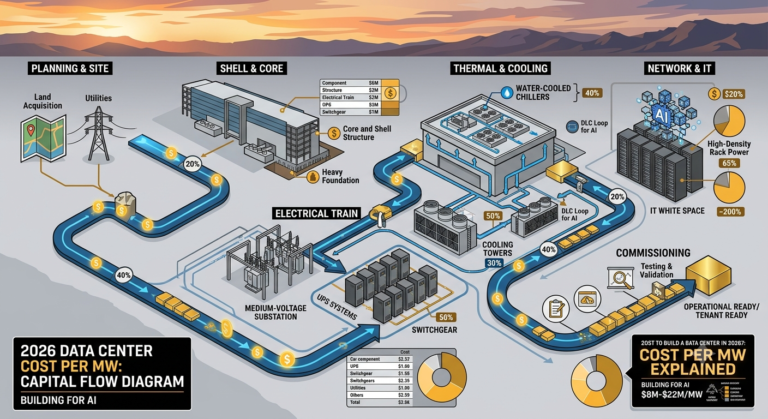
Power is now the main constraint in most markets. For a closer look at facility power costs and capacity, see our data center cost per MW guide. Confirm:
- Maximum power density the facility can deliver today (not in a future phase)
- Cooling technology and liquid-cooling readiness
- Actual PUE performance versus marketed numbers
- Ability to increase power allocation without forcing a move
- How power is metered and billed (committed kW vs actual usage)
If your workloads include AI or high-performance computing, this pillar becomes the highest priority when you choose the right data center provider.
Pillar 3: Connectivity and Network Ecosystem
A data center without strong connectivity is just expensive real estate. Evaluate:
- Carrier neutrality and number of on-net carriers
- Available cloud on-ramps (AWS, Azure, Google Cloud, and others)
- Cross-connect pricing and lead times
- Latency to your users, partners, and key cloud regions
- Diverse fiber paths into the facility
Dense interconnection options lower both cost and complexity for hybrid and multi-cloud setups.
Pillar 4: Security and Compliance
Physical and logical security must match your risk profile. Review:
- Layered physical security (access control, biometric, mantraps, 24/7 staffing)
- SOC, NOC, and monitoring capabilities
- Relevant compliance certifications and the shared responsibility model
- Audit support and reporting practices
- Incident response and notification procedures
Never assume a provider’s certifications automatically cover your specific obligations.
Pillar 5: Location, Latency, and Data Sovereignty
Location affects performance, risk, and regulatory compliance. For a market-specific example, see our guide to data centres in Pakistan. Consider:
- Proximity to end users and business partners
- Natural disaster and geopolitical risk
- Local power grid reliability and cost
- Data residency and sovereignty requirements
- Accessibility for your staff and partners
Many organizations now use multi-site strategies to balance latency, resilience, and compliance.
Pillar 6: Total Cost of Ownership (TCO)
The lowest monthly rack price is rarely the lowest true cost. Build a 3–5 year TCO model that includes:
- Space and power charges
- Cross-connect and bandwidth fees
- Remote hands and smart hands costs
- Installation and migration expenses
- Contract escalators and renewal pricing
- Potential downtime risk cost
Power is usually the largest variable. Understand exactly how it is calculated and whether cooling is included. Our data center colocation pricing guide explains how rack, power, and bandwidth charges fit together.
Pillar 7: Scalability and Future-Proofing
Your needs will change. Confirm the provider can support:
- Additional power and space without relocation
- Higher density deployments (especially liquid cooling for AI)
- Flexible contract terms for growth or contraction
- Technology refresh and upgrade policies
- Clear expansion roadmap for the facility itself
A provider that cannot scale with you forces expensive moves later.
Pillar 8: Support Quality and Partnership
Technical infrastructure means little without responsive operations. Assess:
- Remote hands / smart hands response times and quality
- Customer portal and API maturity
- Account management model
- Transparency during incidents
- References from similar customers
Talk to existing customers whenever possible. Operational culture is hard to measure on paper but critical in practice.
Practical Decision Tools
Weighted Scoring Matrix
Assign weights to each of the eight pillars based on your priorities (for example, power density 25 %, TCO 20 %, connectivity 15 %, etc.). Score every shortlisted provider and calculate a total weighted score.
Red Flags That Should Eliminate a Provider
- Vague or delayed answers about available power
- Inability to show recent independent audit reports
- Restrictive exit clauses or high early-termination fees
- No clear path to higher density or liquid cooling
- Poor or non-existent references from similar customers
- Marketing claims that cannot be verified with data
Site Visit Checklist
When you visit, inspect:
- Actual customer racks and power distribution
- Cooling systems and containment
- Meet-me room and cross-connect facilities
- Security processes in action
- On-site engineering and operations staff
Common Mistakes When Choosing a Data Center Provider
- Focusing only on monthly price instead of full TCO
- Underestimating future power density needs
- Ignoring interconnect and egress costs
- Accepting weak exit and renewal terms
- Choosing a well-known brand without matching it to your specific requirements
- Failing to test remote hands response times before signing
Special Considerations for Different Business Needs
AI and High-Density Workloads
Prioritize facilities that already support 40 kW+ per rack and have liquid cooling options. Traditional air-cooled halls will become a bottleneck quickly.
Regulated Industries
Map every compliance requirement first, then filter providers that can show the necessary certifications and audit support.
Hybrid and Multi-Cloud Environments
Focus on carrier density, cloud on-ramps, and low-latency private connectivity.
Growing Companies
Look for flexible contracts, modular expansion options, and transparent scaling pricing.
How to Run the Final Selection Process
- Finalize your requirements document.
- Build a shortlist of 3–5 providers that pass basic filters (location, power, compliance).
- Issue a focused RFP or structured questionnaire.
- Score responses using your weighted matrix.
- Conduct site visits and reference calls.
- Negotiate commercial terms, focusing on power pricing, escalators, exit clauses, and SLA credits.
- Document the decision and the reasons for it.
Future Trends That Will Affect Your Choice
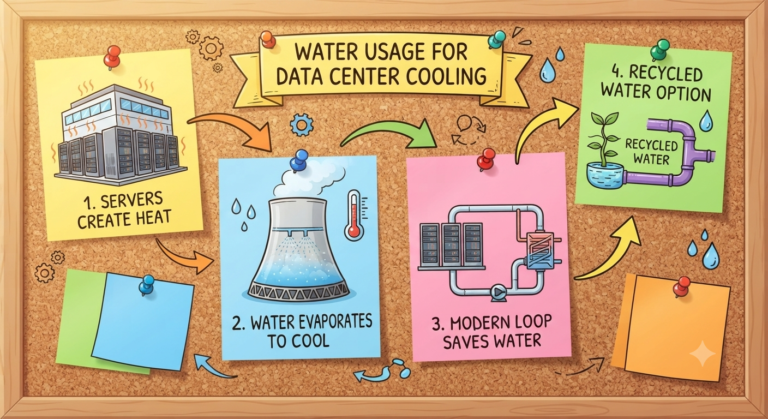
Power availability and delivery timelines continue to tighten in many markets. Liquid cooling is moving from optional to expected for high-density deployments. Sustainability reporting and water usage effectiveness (WUE) are becoming standard evaluation points. Data sovereignty rules keep expanding. Providers that invest early in these areas will be better positioned to support long-term business needs.
Final Checklist: How to Choose the Right Data Center Provider for Your Business Needs
- Have you clearly defined current and future power, density, and compliance requirements?
- Does the provider meet those requirements today?
- Have you modeled full 3–5 year TCO including all variable costs?
- Are connectivity options and latency acceptable for your workloads?
- Is the contract flexible enough for growth or change?
- Have you checked operational quality through references and, ideally, a site visit?
- Do you understand exactly what happens if the relationship needs to end?
Conclusion
Learning how to choose the right data center provider for your business needs comes down to clear preparation and objective evaluation. Start with your own requirements, apply the eight-pillar framework consistently, calculate true total cost of ownership, and verify claims with data and references. Follow this process and you greatly increase the chance of selecting a provider that supports both your current operations and future growth.
The right data center provider is not the one with the flashiest marketing or the lowest advertised price. It is the one that best matches your specific technical, commercial, and operational requirements while leaving room to adapt as those requirements change.



One Comment
Comments are closed.