How to Calculate Solar Panel Cost: A Step-by-Step Formula With Real 2026 Numbers
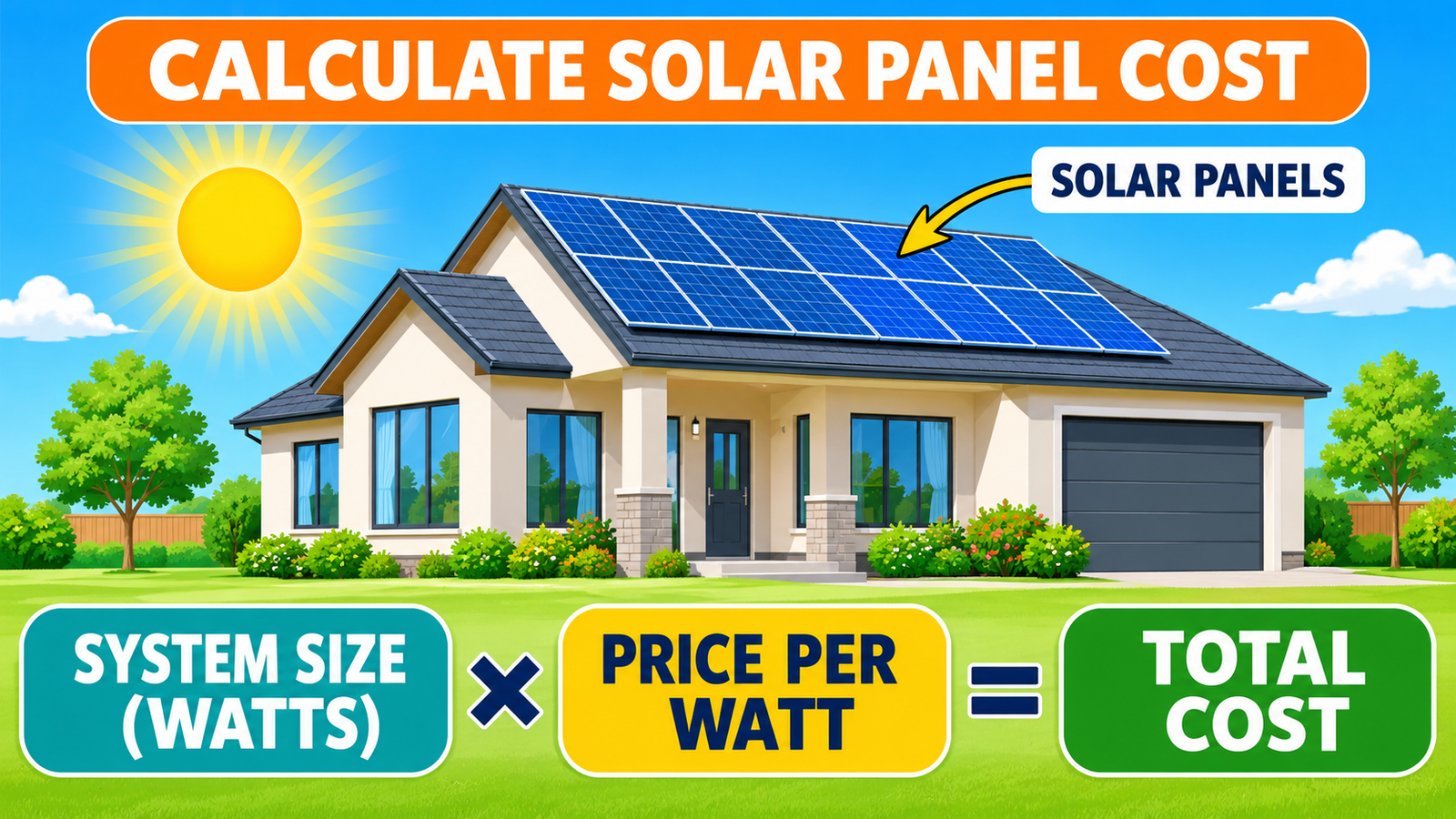
To calculate solar panel cost, multiply your system size in watts by the installed price per watt. At the 2026 US benchmark of $3.36 per watt before incentives, a 7 kW system costs about $23,520. Add extras such as batteries or roof work, then subtract any incentives you qualify for.
The Basic Formula
Solar quotes are built on one number: dollars per watt of installed capacity. So the calculation is short.
Total cost = system size (watts) × price per watt + extras − incentives
The hard part isn’t the arithmetic. It’s choosing the right system size and a realistic price per watt. The steps below cover both. All figures here are for the United States.
Five Steps to Your Own Number
Step 1: Find your annual electricity use
Add up the kilowatt-hours (kWh) on your last 12 utility bills. If you don’t have them, the US Energy Information Administration puts the average US household at about 10,500 kWh a year. Your own history beats any average, especially if you plan to add an electric vehicle or heat pump.
Step 2: Estimate how much one kilowatt of panels produces
This varies by location, roof angle, shading and system losses. NREL’s free PVWatts Calculator estimates output from your address, using 30 years of weather data. Note the annual kWh it reports per kW of panels. You’ll divide by it next.
Step 3: Size the system
System size (kW) = annual kWh needed ÷ annual kWh produced per kW
Many people aim to cover all of their use, but your utility’s rules on selling surplus power to the grid can justify a smaller system. Ask the utility before you settle on a size.
Step 4: Multiply by price per watt
The benchmark in the third quarter of 2026 was $3.36 per watt installed before incentives, according to figures from SEIA and Wood Mackenzie as reported by Solar.com. That was down 1.4% from a year earlier. Local quotes will differ, and Solar.com’s own California average was lower, at $2.95 per watt.
Step 5: Add extras, subtract incentives
Batteries, electrical upgrades and roof work often sit outside the per-watt price. Incentives come off the end. Both are covered below.
A Worked Example
Take a household using the national average. Two inputs below are assumptions chosen to show the method: 1,400 kWh produced per kW each year, and an electricity rate of $0.20 per kWh. Replace them with your PVWatts result and your own rate.
| Step | Calculation | Result |
|---|---|---|
| Annual use | EIA household average | 10,500 kWh |
| System size | 10,500 ÷ 1,400 (assumed yield) | 7.5 kW |
| Base cost | 7,500 W × $3.36 | $25,200 |
| With a panel upgrade | Add $1,500–$4,000 | $26,700–$29,200 |
| Yearly bill savings | 10,500 × $0.20 (assumed rate) | $2,100 |
| Simple payback | $25,200 ÷ $2,100 | About 12 years |
The payback figure is deliberately crude. It ignores rate changes, panel degradation, financing costs and how your utility credits exported power, any of which can move it by years.
To count panels, divide system watts by the wattage of one panel. With an assumed 400 W panel, 7,500 W needs about 19 panels.
Cost by System Size
These totals apply the $3.36 benchmark to common sizes, before incentives and extras. Larger systems tend to cost less per watt because fixed project costs are spread across more capacity, so treat the bigger rows as slightly high.
| System size | Total cost |
|---|---|
| 4 kW | $13,440 |
| 5 kW | $16,800 |
| 6 kW | $20,160 |
| 7 kW | $23,520 |
| 8 kW | $26,880 |
| 10 kW | $33,600 |
| 12 kW | $40,320 |
What the Price Pays For
Panels are a smaller slice than most buyers expect. Solar.com’s breakdown of the per-watt price shows that design, sales and other soft costs make up roughly half of the total.
| Component | Share | Per watt |
|---|---|---|
| Design, overhead, administration | ~30% | $1.01 |
| Racking and electrical parts | ~18% | $0.60 |
| Customer acquisition | ~18% | $0.60 |
| Inverter | ~12% | $0.40 |
| Solar panels | ~11% | $0.37 |
| Installation labor | ~8% | $0.27 |
| Permits, inspection, utility hookup | ~3% | $0.10 |
One practical use: if two quotes differ by a dollar a watt, the gap is almost never the panels. Ask where it comes from.
Costs the Per-Watt Price Leaves Out
Solar.com lists these as possible add-ons that sit outside the benchmark:
- Home battery: $10,000–$20,000
- Main electrical panel upgrade: $1,500–$4,000
- Roof repair or replacement: $10,000–$25,000 or more
- Ground mount: roughly $0.25–$0.50 more per watt
A roof that needs replacing soon is the most expensive surprise. Replacing it first is usually cheaper than removing and reinstalling panels later.
Incentives in 2026
The 30% federal tax credit for homeowners who buy a system (Section 25D) ended after 2025, according to EnergySage. The same report says solar companies that offer leases and power purchase agreements can still claim a 30% credit under Section 48E, but that benefit goes to the company, not to you.
Because the credit is gone, the price-per-watt formula above is also your net cost for most 2026 purchases, unless a state, utility or local program applies. Check those separately, and confirm tax questions with a tax professional. This article is general information, not financial or tax advice.
Frequently Asked Questions
How do you calculate the cost of solar panels?
Multiply system size in watts by the price per watt, add extras such as batteries or roof work, then subtract incentives. At $3.36 per watt, a 5 kW system costs about $16,800 before extras.
What size solar system do I need?
Divide your annual kWh use by the kWh one kW of panels produces at your address. PVWatts gives that production figure. The household average of 10,500 kWh a year is a starting point only.
Is the price per watt lower for bigger systems?
Generally yes. Fixed costs such as permitting and design are spread over more capacity, so the per-watt price falls as the system grows.
Can I still claim the federal solar tax credit?
The homeowner credit under Section 25D ended after 2025, per EnergySage. Leases and power purchase agreements can still pass some benefit through the provider’s own credit, but not as a tax credit to you.
Before You Sign a Quote
Get at least three quotes and compare them in dollars per watt, not totals. Check that each includes the same system size, and ask what is excluded: panel upgrades, roof work and monitoring are common gaps. Then rerun the formula with each installer’s figures.