Silencing the Hum: Engineering and Regulatory Solutions for Data Center Noise Pollution
Data center noise is continuous, low-frequency acoustic output generated primarily by mechanical cooling systems, transformers, and backup power generators. Mitigating property-line noise requires switching from standard A-weighted (dBA) measurements to C-weighted (dBC) or octave-band frequency analysis to identify structural resonance. Implementing sound barriers, variable frequency fan drives, and liquid cooling architectures ensures compliance with international acoustic standards and protects community health.
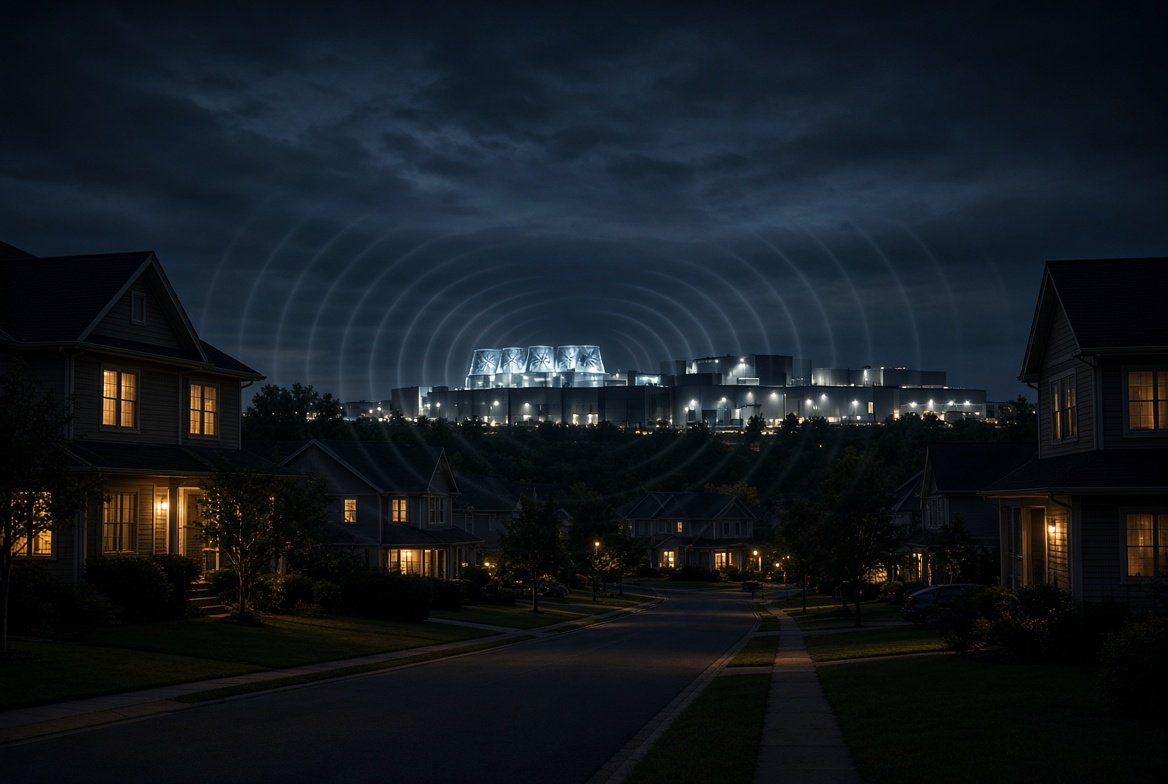
I remember taking a late-evening walk past a newly constructed hyperscale facility in my neighborhood. A low, persistent hum hung in the air, cutting through what used to be a quiet suburban street. That experience changed how I view high-density computing; it made me realize that heat management is only half the battle. If we do not address community sound boundaries, local permitting will stop compute expansion in its tracks.
Understanding Data Center Noise Pollution in Urban Areas
Data center noise pollution originates from the heavy mechanical and electrical infrastructure required to keep facilities running 24/7. When artificial intelligence workloads scale up, thermal dissipation requirements spike, forcing cooling equipment to work at maximum capacity. This creates continuous environmental sound emissions that nearby residents often describe as an inescapable industrial drone.
Why Low-Frequency Noise dBC Matters in Acoustic Auditing
Municipal ordinances typically measure sound using dBA levels, which account for human ear sensitivity to mid-to-high frequencies. However, large chillers and transformers emit low-frequency noise in the 20 Hz to 200 Hz range. Standard dBA meters filter out these low tones, masking severe structural vibrations that pass straight through residential walls. Switching to dBC weighting and unweighted 1/3 octave band frequency spectrum analysis provides a true picture of property-line noise levels.
Managing Server Hall Decibel Levels to Protect Operators
Inside the server hall, high-RPM chassis fans create intense broadband white noise ranging between 85 dBA and 95 dBA. Facilities must follow ASHRAE TC 9.9 acoustic guidelines to protect technicians working in hot aisles.
| Subsystem / Location | Sound Level | Dominant Frequency Range | Operational Profile |
|---|---|---|---|
| Air-Cooled Chillers | 75–88 dBA @ 3m | 100–500 Hz | Continuous low-to-mid frequency hum |
| Server Hall Hot Aisles | 85–95 dBA | 1 kHz–4 kHz | High-pitch broadband chassis fan noise |
| Step-Down Transformers | 60–75 dBA @ 1m | 50–60 Hz / 100–120 Hz | Persistent electrical magnetostriction hum |
| Backup Generators (Test) | 95–110 dBA @ 7m | Full spectrum (<100 Hz exhaust) | Intermittent high-amplitude pulse sound |
Proven Air-Cooled Chiller Noise Mitigation Strategies
To cut noise at the source, operators should apply targeted mechanical controls:
- Variable Frequency Drives (VFDs): Installing VFDs allows fan speeds to drop during cooler nighttime hours, lowering acoustic output exponentially.
- Diffuser-Blade Fans: Upgrading to serrated trailing-edge fan blades minimizes airflow turbulence at the blade tip.
- Acoustic Louvers & Silencers: Enclosing air intake plenums with sound-absorbing baffles traps mid-frequency mechanical tones before they escape.
Applying WHO Environmental Noise Standards to Data Facilities
Public health entities report that chronic exposure to nighttime industrial hums elevates stress levels and interrupts sleep patterns. The World Health Organization (WHO) Guidelines for Community Noise recommend keeping continuous nighttime noise outside bedroom windows below 45 dBA, with an indoor limit of 30 dBA. Modern facility developers must design layouts that respect these threshold limits under all operating conditions.
Exploring Liquid Cooling Acoustic Benefits for High-Density Systems
The most effective way to eliminate noise is to abandon forced-air mechanical systems entirely. Deploying direct-to-chip liquid cooling or two-phase immersion cooling removes high-RPM server fans and reduces external chiller loads. Transitioning to closed-loop liquid systems can drop boundary line sound pressure levels by up to 20 dB while drastically reducing facility energy consumption.
Frequently Asked Questions
Why does data center noise sound so loud even when dBA levels are low?
Standard dBA meters suppress low frequencies below 200 Hz. Data center chillers emit strong low-frequency tones that pass through walls and resonate inside homes, even if the dBA reading appears compliant.
How far can unmitigated data center noise travel?
Under neutral atmospheric conditions, continuous cooling noise can travel anywhere from 1,500 feet to over three-quarters of a mile, especially during nighttime atmospheric inversions.
What standards govern data center noise compliance?
Facilities must comply with local municipal zoning codes, ISO 1996 environmental sound assessment criteria, WHO Community Noise Guidelines, and ASHRAE TC 9.9 workplace exposure guidelines.
Future Thought and Further Reading
As high-density AI clusters push power draws higher, acoustic containment will become as important to data center site selection as grid capacity and water access. Operators who invest early in liquid cooling and low-frequency mitigation will avoid costly community disputes and regulatory delays.
- ISO 1996-1: Environmental Noise Description and Assessment Standards
- WHO Guidelines for Community Noise and Night Noise Protection
- ASHRAE TC 9.9 Datacom Equipment Acoustic Best Practices