
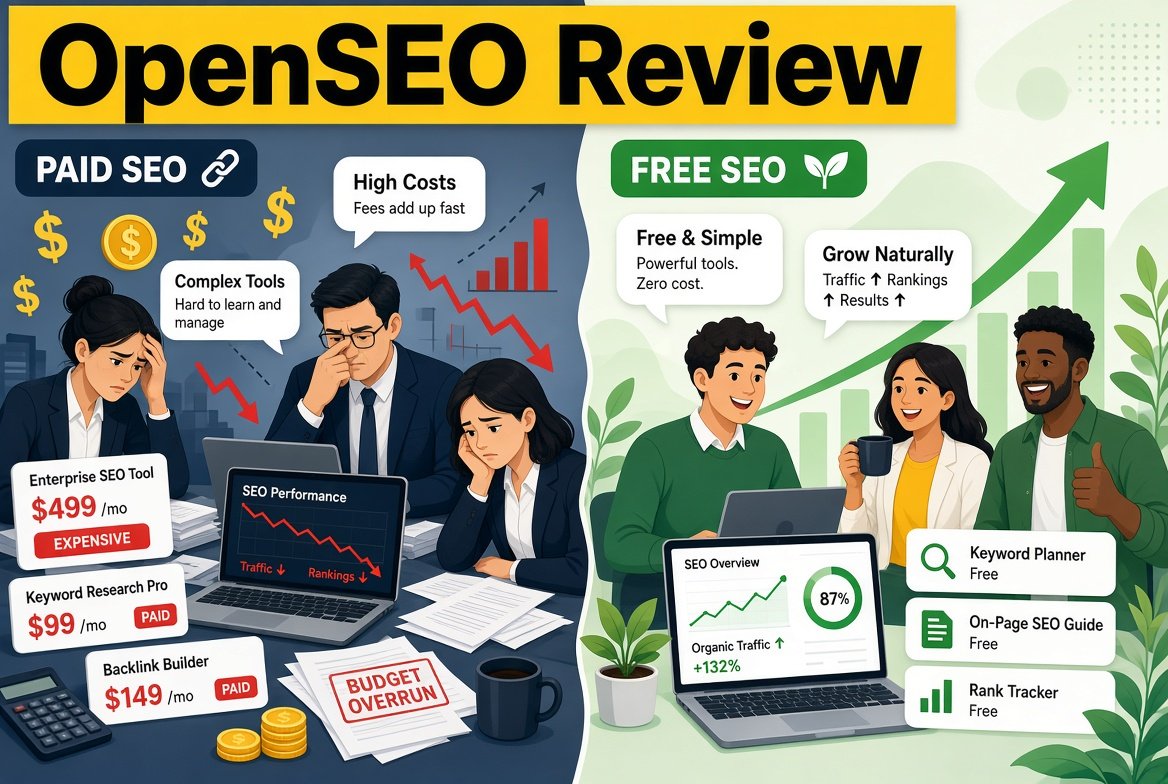
OpenSEO Review 2026: The $10 Open-Source SEO Tool for AI Agents
OpenSEO review in brief: OpenSEO is a free, MIT-licensed, open-source SEO platform that gives AI agents like Claude Code, Codex and ChatGPT direct access to keyword, backlink, rank-tracking, site-audit and AI-visibility data through an MCP server. It pulls its data from DataForSEO, so you pay per lookup instead of a monthly seat: $10 a month on the hosted version (which includes $10 of usage), or only DataForSEO’s base rates if you self-host with Docker or Cloudflare. As of November 2026, it suits solo founders, indie SEOs and developers who want Ahrefs-style research without a $129-plus subscription, but it does not match Ahrefs or Semrush on backlink depth or traffic-estimate accuracy.
Last updated: November 4, 2026. This OpenSEO review is built from the official GitHub repository, the openseo.so documentation and pricing pages, and independent hands-on reviews. We did not run our own tests, and where sources disagree we say so.
What Is OpenSEO?
OpenSEO is an open-source SEO tool that works as a pay-as-you-go alternative to Semrush and Ahrefs. Its code lives in the every-app/open-seo repository on GitHub under an MIT license, which means anyone can run it, fork it and change it. The project was published by Every App, Inc. and, according to one hands-on reviewer, started in February 2026 when its developer, Ben Senescu, priced out the established SEO suites for his own sites.
The idea is simple. Instead of building another dashboard full of charts, OpenSEO exposes every feature as a tool your AI agent can call. You ask your agent to find keywords, check who ranks, pull a backlink profile or audit a site, and the agent fetches live data and works with it. The web app is still there for people who prefer clicking.
Traction has been fast for a new project. It reached the number one Product of the Day spot on Product Hunt on July 19, 2026, and the GitHub repository now shows roughly 26,000 stars and 3,600 forks.
OpenSEO Review: Quick Facts
| Attribute | Detail |
|---|---|
| Type | Open-source SEO platform with an MCP server |
| License | MIT |
| Data source | DataForSEO APIs, plus Google Search Console |
| Hosted price | $10 per month, includes $10 of usage |
| Self-hosted price | App is free; you pay DataForSEO directly |
| Core workflows | Keyword research, rank tracking, competitor insights, backlinks, site audits, AI visibility |
| Agent support | Claude Code, Codex, ChatGPT, Cursor, OpenClaw, Hermes |
| Self-hosting paths | Docker, Cloudflare (works on the free plan) |
| Maturity | Early stage; version numbers still start with 0.1 |
| Community | Discord and direct email to the maintainer |
How Does OpenSEO Work?
OpenSEO sits between three things: a data provider, a web app and your AI agent. Understanding that chain explains both its low price and its limits.
- DataForSEO supplies the data. OpenSEO has no crawler or link index of its own. Keyword volumes, difficulty scores, intent labels, SERP results and backlinks come from DataForSEO’s commercial APIs, and each lookup has a small cost.
- OpenSEO organizes it. The app wraps those APIs in focused pages for keywords, domains, backlinks, rankings and audits, and stores your projects and reports.
- Your agent uses it. The built-in MCP server lets an AI agent run the same actions, and reusable Agent Skills guide it through multi-step jobs such as keyword clustering or competitor analysis.
Because of this design, data quality follows DataForSEO. Reviewers who tested it call the data solid for major English-language markets and less impressive elsewhere.
OpenSEO Features
Keyword Research
Keyword research is the core workflow. One hands-on test of the query “seo api” returned search volume, CPC, competition, a difficulty score and an intent label for 92 related keywords, along with twelve months of trend data and a live SERP breakdown. Results export to CSV and Google Sheets.
Rank Tracking
Rank tracking supports desktop and mobile results, city-level local targeting and scheduled checks. Cost depends mostly on how often you check and how many keywords you track.
Competitor Insights and Domain Overview
Enter any domain to see estimated organic traffic, ranking keywords and competing sites. Traffic figures are estimates built from DataForSEO data, so treat them as directional.
Backlink Analysis
The backlink workflow shows referring domains and links for a domain or a single page. The README prices a domain check at about $0.06 and a page check at about $0.04 at base DataForSEO rates.
Technical Site Audits
OpenSEO includes its own crawler for technical checks: broken links, missing or duplicate titles and descriptions, canonicals, redirect chains, indexability and structured data, with Lighthouse performance data per page. It does not judge content quality or semantic coverage, which is a deliberate scope choice.
AI Visibility and Prompt Explorer
Two features target AI search. A brand lookup shows how a brand appears in answers from ChatGPT and Google AI Overviews, including competitor mentions and cited sources. A prompt explorer runs one prompt across several language models side by side. One independent write-up puts a ChatGPT brand check at roughly $1.09, so this is the most expensive action in the tool.
Google Search Console
Google Search Console connects natively, and the project also offers a separate Search Console MCP. Search Console data is free, so these lookups do not use credits.
How Does the OpenSEO MCP Server Work?
MCP, the Model Context Protocol, is a standard way for AI agents to call external tools. OpenSEO exposes every feature through an MCP server, so a connected agent can research keywords, pull backlinks, check rankings and launch audits mid-task instead of giving generic advice from training data.
Which AI Agents Work With OpenSEO?
The documentation covers Claude Code, Codex, ChatGPT (web and desktop, including free plans), Cursor, OpenClaw and Hermes. Other MCP-compatible clients should connect the same way.
How Do You Connect an Agent?
In the app, open the AI and MCP page and copy your server URL. For the hosted app, Codex connects with one command, and you approve the OpenSEO login when prompted:
codex mcp add openseo --url https://app.openseo.so/mcp
To add the prebuilt Agent Skills for Claude Code and Codex, run npx skills add every-app/open-seo --skill '*'. Skills cover keyword research, competitor analysis, audits, Search Console review, SEO coaching and local SEO.
OpenSEO Pricing: How Much Does It Cost?
OpenSEO has two cost layers, and mixing them up is the most common mistake in other write-ups. The app itself is free under the MIT license. The data costs money, because DataForSEO charges per request.
| Option | Monthly cost | What you manage |
|---|---|---|
| Hosted (openseo.so) | $10, includes $10 of usage; extra usage billed per action | Nothing. Data and integrations are set up for you. |
| Self-host on Cloudflare | $0 for the app on Cloudflare’s free plan, plus DataForSEO usage | Your Cloudflare account and a DataForSEO key |
| Self-host with Docker | Server cost (one template quotes about $5 to $15 on Railway at light use), plus DataForSEO usage | Server, updates and access control |
The hosted service adds a 28 percent markup to every DataForSEO request, a figure published in the project’s own README. That means self-hosted usage costs about 22 percent less than the same usage on the hosted plan, because 1 divided by 1.28 is roughly 0.78. Some write-ups round this to “28 percent cheaper,” which overstates the saving.
What Does Typical Usage Cost?
Using the hosted rates of about $0.05 per keyword search and $0.08 per backlink check, here is what three usage levels look like. Self-hosted figures divide the hosted usage by 1.28 and exclude server costs.
| Scenario | Monthly usage value | Hosted total | Self-hosted usage |
|---|---|---|---|
| Light: 100 keyword searches | $5 | $10 (credit covers it) | $3.91 |
| Medium: 250 searches plus 90 backlink checks | $19.70 | $19.70 | $15.39 |
| Heavy: agency-style research | $100 | $100 | $78.13 |
The light case shows why hosted wins for casual users: you pay $10 whether you use $3 or $10 of credit, but you avoid any setup. The heavy case shows why self-hosting wins at volume. Either way, even the heavy scenario is below the roughly $129 per month entry price cited for Ahrefs and the $139.95 cited for Semrush, though those plans bundle far more data and features.
Two caveats on DataForSEO itself. Its documentation as of early 2026 listed a $1 free test credit and a $50 minimum top-up, while another reviewer described the minimum as low, so check the current terms before you commit. Also, one directory lists a $0.50 hosted trial and another review found no trial, so confirm on the pricing page.
How to Self-Host OpenSEO
Docker Setup
- Create a DataForSEO account and copy your API credentials. OpenSEO expects them as the Base64 encoding of login:password, which DataForSEO’s dashboard provides ready-made.
- Run
git clone https://github.com/every-app/open-seoand move into the folder. - Copy the example environment file with
cp .env.example .envand add your key. - Start it with
docker compose up -d. - Open port 3001. One reviewer had the dashboard running in about 40 seconds. If the port is taken, set PORT in the .env file.
The first visitor creates the admin account, and teammates join through invitation links. Even so, put the instance behind a proxy or private network rather than exposing it openly.
Cloudflare Setup
The Cloudflare route needs no server: one deploy command or button puts OpenSEO on your own Cloudflare account, and the project says it works on the free plan. Cloudflare Access can sit in front for extra control.
Privacy Note
The app sends anonymized usage telemetry tied to a random install ID, with no URLs or keywords, and an environment variable switches it off. Reviewers noted that this is documented openly rather than hidden.
OpenSEO vs Ahrefs vs Semrush
| Factor | OpenSEO | Ahrefs | Semrush |
|---|---|---|---|
| Entry price | $10 per month, or free self-hosted plus data | About $129 per month | About $139.95 per month |
| Pricing model | Pay per lookup | Subscription | Subscription |
| Own data index | No, uses DataForSEO | Yes, large crawler and link index | Yes, large proprietary database |
| Backlink depth | Useful, smaller index | Industry benchmark | Strong |
| AI agent access | Native MCP and Agent Skills | Own interface and API | Own interface and API |
| Self-hosting | Yes | No | No |
| Source code | Open, MIT | Closed | Closed |
| Breadth of tools | Focused workflows | Broad | Very broad |
Competitor prices change often and some reviewers list cheaper starter tiers, so check each vendor’s live pricing page. The structural difference matters more than the exact number: Ahrefs and Semrush own their data, and OpenSEO rents it.
OpenSEO Pros and Cons
| Pros | Cons |
|---|---|
| Very low cost for light and moderate use | Smaller backlink index and rougher traffic estimates than the big suites |
| Best-in-class MCP server and Agent Skills for an SEO tool | Early-stage software with changing features |
| MIT license: fork it, audit it, self-host it | Needs a DataForSEO account when self-hosting |
| Transparent pricing, including the published 28 percent markup | Usage costs rise with heavy rank tracking and AI brand checks |
| Covers keywords, ranks, links, audits and AI visibility in one place | Audit is technical only, with no content-quality scoring |
| No per-seat fee on the hosted plan | Data coverage is weaker outside major English-language markets |
| Active maintainer and Discord community | Agency features such as client reports are still on the roadmap |
Who Should Use OpenSEO?
| You are… | Verdict | Why |
|---|---|---|
| A solo founder or blogger | Good fit | Low cost, enough data for keyword and content decisions |
| A developer or SEO who works with coding agents | Excellent fit | The MCP design is the main reason to choose it |
| A small team watching its budget | Good fit | No seat fees, one $10 plan for unlimited users |
| A link-building specialist | Partial fit | Useful for prospecting, but Ahrefs still has the deeper link data |
| An agency tracking thousands of keywords daily | Poor fit today | Usage costs and missing client-reporting features |
| Someone who wants content-quality scoring | Pair it with another tool | OpenSEO skips on-page content analysis on purpose |
Is OpenSEO Safe and Legit?
The code is public, MIT-licensed and actively maintained, with hundreds of commits, open issues and merged outside contributions. The hosted version’s pricing logic is visible in the repository, which is rare for SEO software. The main risks are practical rather than ethical: it is young, its data depends on a third party, and a self-hosted instance exposed to the internet without access control is a security problem you would own. Use the built-in accounts, a private network or Cloudflare Access.
What Is Coming Next for OpenSEO?
The public roadmap lists local SEO, custom client reports, improved and scheduled site audits, an in-app AI agent and support for multiple projects. The stated top priorities are AI search visibility, better Claude support through MCP, and stronger agent workflows for SEO. Several of today’s gaps, especially reporting and audits, are therefore known and planned, but roadmap items are not guarantees.
OpenSEO Alternatives
| Tool | Best for | Trade-off |
|---|---|---|
| Ahrefs | Backlink research and the deepest link data | Highest price of the group |
| Semrush | All-in-one marketing suite | Complex, subscription-based |
| Google Search Console | Your own site’s real search performance | No competitor data |
| Screaming Frog | Deep desktop crawling and audits | No keyword or rank data |
| Mangools | Simple, affordable keyword research | No MCP-first design or self-hosting |
OpenSEO Review Verdict: Is It Worth It?
For most solo operators and technical SEOs, this OpenSEO review ends in a clear yes. At $10 a month, or the cost of DataForSEO calls if you self-host, it delivers professional-grade keyword, rank, backlink and audit data with the strongest agent integration in the category. It is a trade of depth for cost and control, and that trade is honest and well documented.
Skip it if your work depends on the largest backlink index, precise traffic estimates, or agency-scale reporting. In that case, Ahrefs or Semrush still earn their price. A practical way to decide: connect the hosted plan to your agent, run one real keyword project, and compare the output with a free trial of a bigger suite before committing either way.
OpenSEO FAQ
Is OpenSEO free?
The software is free and open source. The data it uses is not: you pay DataForSEO per request when self-hosting, or $10 a month on the hosted plan, which includes $10 of usage.
Is OpenSEO really open source?
Yes. It is published on GitHub under the MIT license, so you can self-host, modify and fork it.
Where does OpenSEO get its data?
From DataForSEO’s APIs, with Google Search Console as an additional source. OpenSEO does not run its own search index.
Which AI agents work with OpenSEO?
Claude Code, Codex, ChatGPT, Cursor, OpenClaw and Hermes are documented, and any client that supports MCP should be able to connect.
Is OpenSEO a good alternative to Ahrefs or Semrush?
For research workflows, increasingly yes. As a full like-for-like replacement, not yet, mainly because of backlink depth, traffic-estimate accuracy and reporting features.
Can I self-host OpenSEO for free?
The app itself costs nothing to run on Cloudflare’s free plan or on your own Docker host. You still need a DataForSEO account for the data.
How much does a keyword search cost?
Roughly five cents on the hosted plan, and about 22 percent less when self-hosted, based on the published 28 percent markup. Prices can change, so confirm on openseo.so/pricing.
Does OpenSEO track AI search visibility?
Yes. It includes a brand lookup across ChatGPT and Google AI Overviews and a prompt explorer that compares answers across several language models.