7 Agrivoltaics Farming Examples That Work on Real Farms
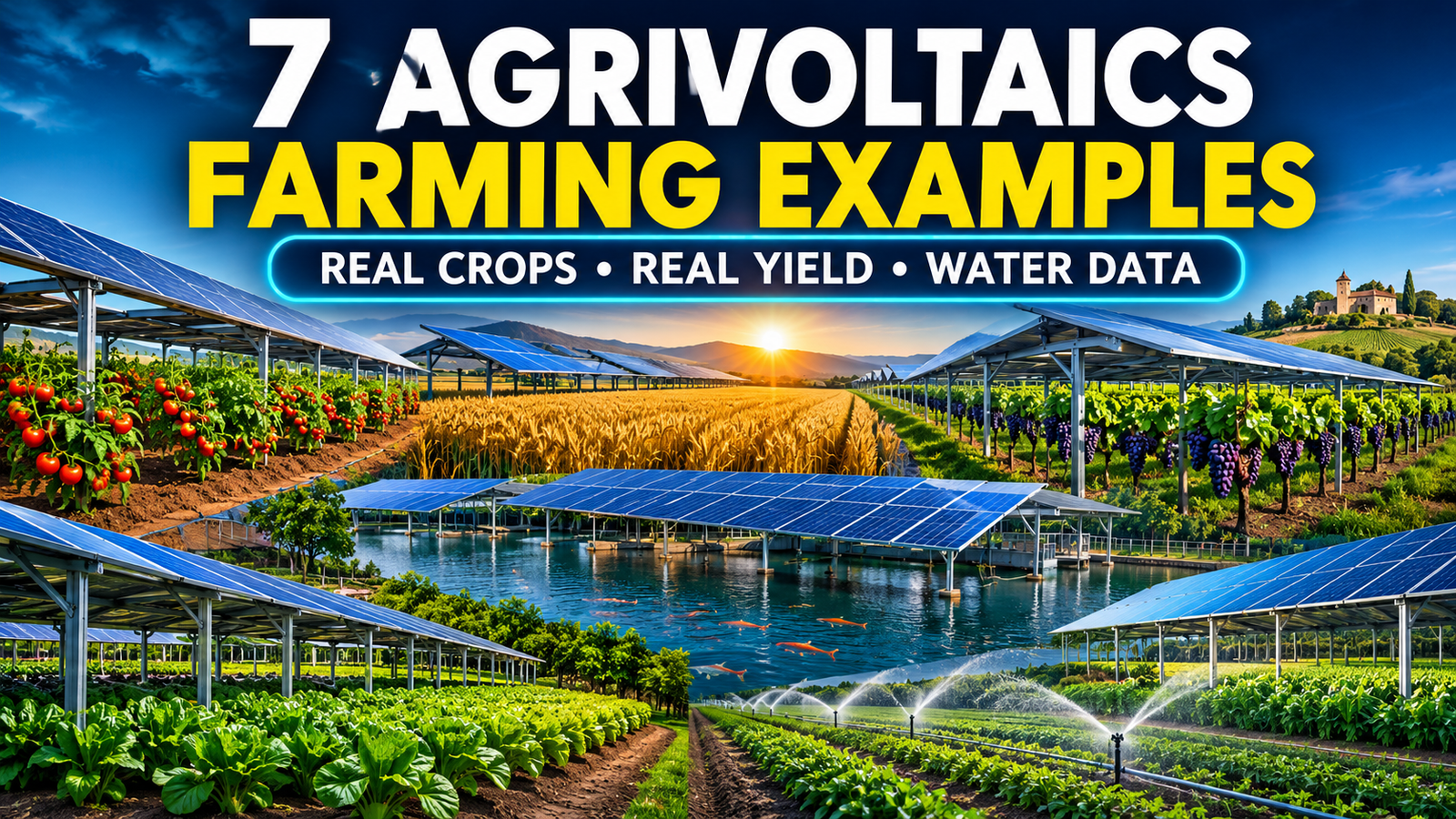
Agrivoltaics farming examples combine solar panels with crops, livestock or fish production on the same land. Well-documented cases include tomatoes in Arizona, vegetables in Colorado, vines in southern France, wheat and potatoes in Germany, grazing sheep in New York, and Taiwan’s fish ponds. Results vary by crop, climate and panel height.
What Agrivoltaics Means in Practice
Agrivoltaics puts solar generation and agriculture on one piece of land instead of choosing between them. The panels can sit on tall frames above crops, stand in rows with planted alleys between them, tilt to follow the sun, or float over water. Underneath, the farm keeps working: vegetables, vines, grazing sheep, wildflowers or fish.
Why the shade matters
Panels change the microclimate beneath them. They cut direct sun, lower air and soil temperature in hot weather and reduce the rate at which plants lose water. The effect runs both ways. Plants release moisture that cools the panels slightly, and cooler panels convert sunlight a bit more efficiently.
None of this is automatic. Shade that helps a pepper in Arizona can starve wheat in a cloudy climate, which is why the examples below are worth reading one by one rather than as a single success story.
Seven Working Examples of Agrivoltaics Farming
1. Biosphere 2, Arizona: tomatoes, peppers and cooler panels
University of Arizona researchers built one of the first dryland agrivoltaic test sites at Biosphere 2 near Oracle. Their 2019 study in Nature Sustainability compared plots under panels with open-sun plots. The university reported that jalapeños produced about the same amount of fruit in both settings while losing 65% less water through transpiration. Cherry tomatoes produced roughly twice as much fruit with 65% better water-use efficiency, and chiltepin fruit output tripled, according to reporting on the study.
The panels benefited too. The same reporting puts the gain at about 3% more electricity during the May–June growing season and about 1% over the year. Small numbers, but they came free with the crops.
2. Jack’s Solar Garden, Colorado: a commercial vegetable farm under tracking panels
Jack’s Solar Garden in Longmont is a working farm and research site run with NREL, Colorado State University and the University of Arizona. It has been described as the largest commercially active agrivoltaic site in the United States, as of 2021. Its single-axis tracking panels are raised so crops can grow in the strips beneath and between them.
A SARE project report describes early, preliminary patterns rather than final yields: leafy crops that stayed productive through summer heat, and some protection from hail and heavy rain. The biggest drag on production so far was pests, mainly grasshoppers and rabbits, not shade. The site also plants pollinator habitat and runs grazing trials.
3. Heggelbach, Germany: wheat and potatoes under five-metre panels
In 2016 Fraunhofer ISE and partners raised a 194 kWp array five metres above an organic farm at Lake Constance. Winter wheat, potatoes, celeriac and clover grass were grown in rotation underneath, and machinery could pass beneath the panels.
The first year was mixed. Clover grass lost only 5.3% of its yield, while potatoes, wheat and celeriac lost 18–19%. Counting food and electricity together, Fraunhofer calculated a land-use efficiency of 160%. In the hot, dry 2018 season, celeriac gained 12% and wheat 3% against the open-field reference, clover grass fell 8%, and land-use efficiency reached 186%. A later analysis found evapotranspiration under the array dropped by roughly 10–23% depending on the crop, with potatoes showing the largest reduction (Fraunhofer ISE conference paper).
The lesson is that shade has a cost in a mild, humid climate and a payoff in a drought year. Both are real.
4. Piolenc and Tresserre, France: panels that tilt to protect vines
Sun’Agri’s dynamic systems use tilting panels, controlled by software, to let sun through when vines need it and shade them during heatwaves. At the Piolenc pilot, 600 m² of a 1,000 m² Grenache plot sat under panels mounted 4.2 metres up. Early results showed growth stunting arriving 6 to 13 days later in shaded vines, water requirements 12–34% lower depending on the setup, and higher anthocyanin and acidity in the grapes, with alcohol levels unchanged.
Treat these as developer-reported pilot figures. A larger 4.5-hectare demonstration at Tresserre followed, and independent, multi-year data on commercial vineyards is still accumulating.
5. Solar grazing with sheep, New York
The simplest agrivoltaic model needs no special structure. Sheep graze under ordinary ground-mounted arrays, replacing mowers and herbicide. New York has been a testing ground, with Cornell studying how grazing affects pollinator habitat and soil carbon. Reporting from the region puts typical payments to sheep farmers at $300 to $500 an acre, while an EDF Renewables grazing plan cites an average of $555 an acre for New York farmers contracting directly in 2018.
The same reporting flags the obstacles: hauling flocks to distant sites, and solar operators who don’t yet know the option exists.
6. Pollinator meadows and grazing, Minnesota
Minnesota leans toward habitat. Minnesota Native Landscapes manages about 60 sites that use sheep grazing alongside pollinator plantings, according to the Agrisolar Clearinghouse. At US Solar’s 1 MW Hancock site in Cologne, sheep graze next to a pollinator-habitat plan and a grazing scorecard, and the project used a USDA REAP loan, per a lender case study. The state has funded research comparing grazing with mowing on these sites.
This model produces wool, meat and habitat rather than a large cash crop, so its value is steadier than spectacular.
7. Aquavoltaics in Taiwan: panels over fish ponds
Taiwan has pushed solar onto fish farms to protect farmland. In 2020 it lowered the minimum size of an aquavoltaic zone from 25 to 10 hectares, according to a 2025 policy study. A National Taiwan University model found that floating panels could cost some fish production, mainly through lower dissolved oxygen, yet the energy income would more than offset the loss.
Delivery has been rough. Taiwan News reported that only 362 of 20,000 zoned hectares had panels by mid-2025, with farmers stuck in shifting reviews. Operators must also show they keep up roughly 70% of historical output. Some earlier projects produced little farming at all, which led to tighter rules. It is the clearest example of why the “agri” part has to be enforced.
Side-by-Side Comparison
| Example | Location | Land use under panels | Headline result |
|---|---|---|---|
| Biosphere 2 | Arizona, USA | Tomatoes, peppers | Less water loss; tomatoes about 2x fruit |
| Jack’s Solar Garden | Colorado, USA | Vegetables, pollinators | Heat-season greens; hail protection (preliminary) |
| Heggelbach | Germany | Wheat, potatoes, celeriac, clover | Land-use efficiency 160% (2017), 186% (2018) |
| Piolenc / Tresserre | France | Grenache vines | Water need down 12–34% (developer-reported) |
| Solar grazing | New York, USA | Sheep pasture | About $300–$555 per acre in grazing income |
| Habitat and grazing | Minnesota, USA | Native flowers, sheep | About 60 managed sites; research under way |
| Aquavoltaics | Taiwan | Fish ponds | Large potential, slow and contested rollout |
Which Crops and Animals Suit Panels
Crops
The evidence favours crops that handle partial shade or suffer in extreme heat: tomatoes, peppers, chard, kale, lettuce and other leafy greens, plus root vegetables at Jack’s Solar Garden. Clover grass was the most tolerant crop at Heggelbach. Cereals and potatoes lost more yield in the cooler first season, so they are a closer call.
Livestock
Sheep dominate because they fit under standard low arrays and graze without damaging equipment. Cattle are being tested too. University of Minnesota Morris has run a dairy-cow agrivoltaics project, which a state legislative document notes, though cows need higher clearance and sturdier designs.
Machinery
Panel height decides what can drive underneath. Researchers in Arizona typically keep panels 6 to 9 feet up, which suits many tractors but not all combines. Heggelbach went to five metres and Piolenc to 4.2 metres for exactly this reason.
The Money Side
Revenue comes from two places: the farming and the power. Solar lease or electricity income usually dwarfs crop income per acre, which is why careful contracts matter. Without a binding farming requirement, a site can drift into an ordinary solar farm with a token crop, the problem Taiwan ran into.
Grazing is the cheapest model to start. Sheep farmers are paid for vegetation control, and solar owners avoid mowing costs. Crop systems cost more up front because of taller structures and wider spacing. US producers may look at USDA programs such as REAP, but eligibility rules and funding change, so check the USDA’s current guidance before planning around it. This section is general information, not financial advice.
Frequently Asked Questions
What are the most common agrivoltaics farming examples?
Solar grazing with sheep is the most widespread, followed by vegetable growing under raised or spaced panels, pollinator meadows, vineyards with tilting panels, and panels over fish ponds.
Do solar panels stunt crop growth?
Sometimes. At Heggelbach, shaded potatoes, wheat and celeriac yielded 18–19% less in 2017, then wheat and celeriac beat the open-field plots in the hot 2018 season. In dry, hot regions, shade often helps; in cool, cloudy ones it can hurt.
Can farm equipment still drive under agrivoltaic mounts?
Yes, if the structure is designed for it. Raised systems at roughly 4 to 5 metres let combines pass, while 6 to 9 foot panels suit many tractors but not large harvesters.
Are the results proven?
Not universally. Several of the strongest numbers come from pilots, single sites or developers, and a few years of data cannot cover every climate. Use them as indicators, then test locally.
Where This Leaves Farmers and Landowners
The better examples share a pattern: the farming was designed first, the panels were placed around it, and someone measured the results. Pick the crop or animal that already suits your climate, then ask what panel height, spacing and contract would protect it.