Data Centers on the Moon and Mars: Sci-Fi or Tomorrow’s Cloud?
Data Centers on the Moon and Mars: Sci-Fi or Tomorrow’s Cloud?
Last week I was doomscrolling tech news at 1 AM (don’t judge me, my chai was strong) when a headline stopped me cold: “There’s Already a Data Center on the Moon.” I nearly dropped my mug. I’ve spent over a year covering AI and cybersecurity, and I thought I had seen every wild claim tech could throw at me.
Turns out, it’s real. Not a rumor. Not a concept render sitting on some startup’s homepage. A tiny data center is genuinely parked on the Moon right now, quietly storing files 384,000 kilometers from your WiFi router. And Mars? Companies are already sketching blueprints for one there too.
In this article, I’ll walk you through what’s actually happening, why anyone would bother, who’s paying for it, and what it means for the future of AI and cloud storage. I’ll also flag where the hype gets ahead of the hardware, because not every claim in this space deserves equal trust. Grab your chai. This one’s a ride.
What Is a Space-Based Data Center? (The 60-Second Lesson)
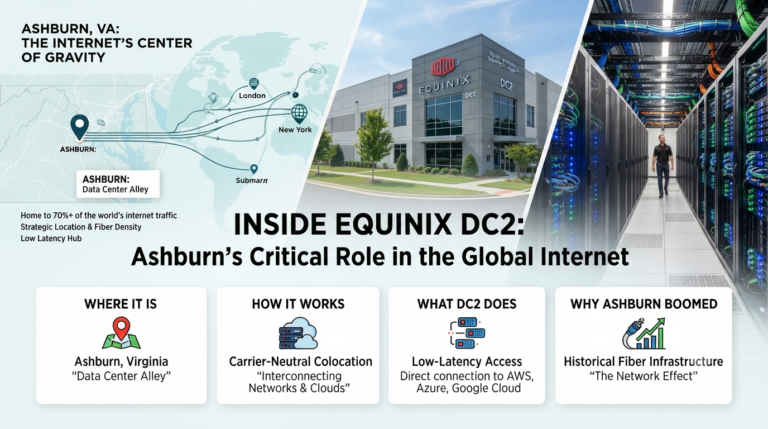
A space-based data center is exactly what it sounds like: servers, storage, and processors that live off Earth instead of in a warehouse in Virginia. Instead of a technician walking in to swap a broken hard drive, robots or remote software do the job. Instead of noisy cooling fans, engineers use the freezing vacuum of space itself.
How It’s Different From the Data Center Down the Street
Your typical Earth-based data center gulps electricity from the grid, and can spend up to 40% of that power just on cooling. A space-based version can tap nearly-constant sunlight for power and the cold of space for cooling, essentially for free. The trade-off? Nobody can drive over with a screwdriver when something breaks.
Three Flavors: Orbit, Moon, and Mars
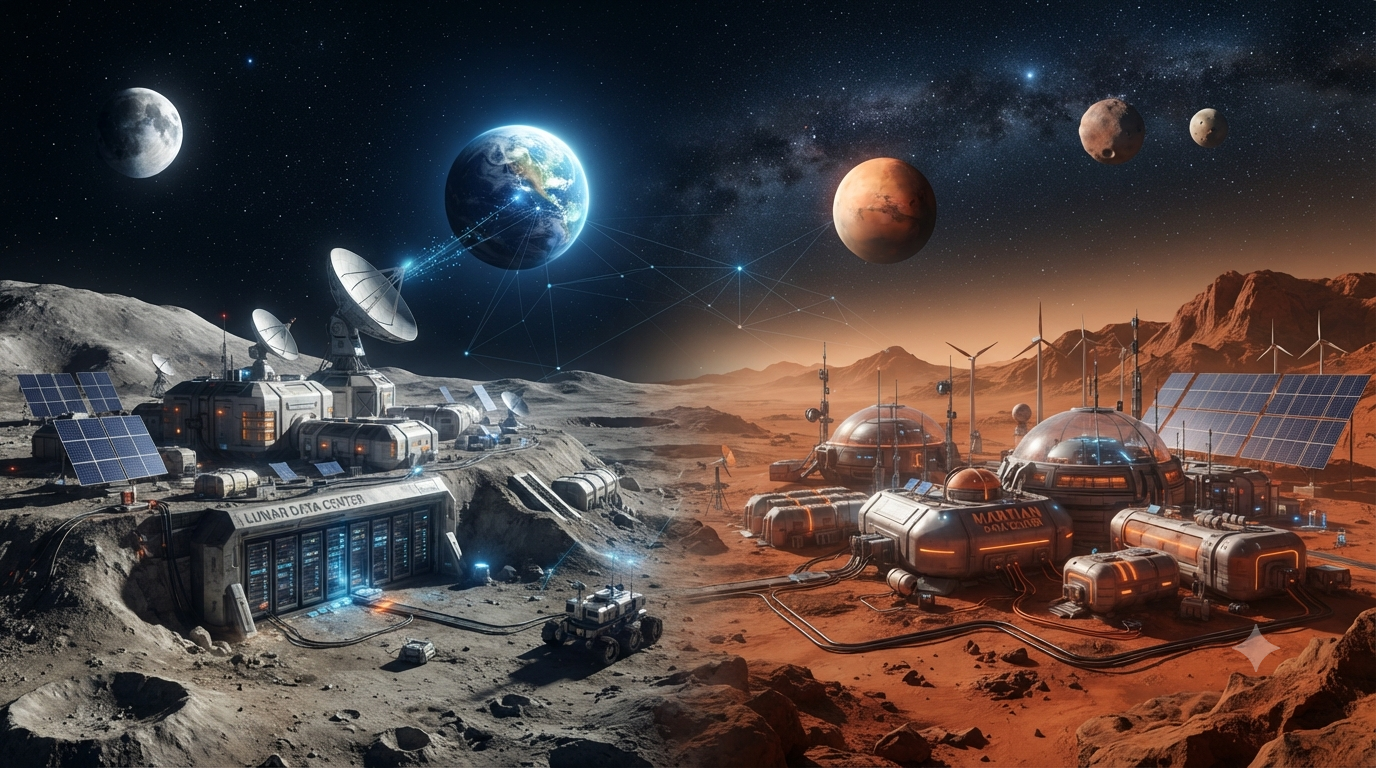
Not all space data centers are built the same way. Some float in low Earth orbit. Some sit at a gravitational parking spot between Earth and the Moon called a Lagrange point. Others are planned for the actual surface of the Moon or Mars. Each option trades off distance, delay, and difficulty differently, so picking one is less “which is best” and more “best for what job.” Here’s how they compare:
| Location | Distance From Earth | One-Way Signal Delay | Power Source | Status in 2026 |
|---|---|---|---|---|
| Low Earth Orbit | ~550 km | <0.01 seconds | Solar (near-constant) | Multiple companies testing |
| Earth-Moon Lagrange Point (L1) | ~60,000 km | ~0.2 seconds | Solar (near-constant) | 6-satellite fleet in progress |
| Moon Surface | ~384,000 km | ~1.3 seconds | Solar (14-day nights) | 1 hardware unit already landed |
| Mars (Orbit/Surface) | 54.6M – 401M km | 4 – 24 minutes | Solar (43% of Earth’s) or nuclear | Concept stage only |
The Moon: Humanity’s First Off-World Data Center (And Yes, It Already Happened)
When I first read this story, I assumed “data center on the Moon” meant some far-off 2040 fantasy. I was wrong by about fifteen years. A Florida company called Lonestar Data Holdings beat everyone to it, and their story reads like a startup movie script.
Meet Lonestar and the Freedom Mission
Lonestar’s first attempt in 2024 was software-only, a kind of dry run riding along with a lunar lander. Their real hardware moment came with the “Freedom” mission: an 8-terabyte solid-state drive paired with a radiation-tough processor, built with storage partner Phison. It landed on the Moon, tipped onto its side, and still managed to send data home before power ran out.
The Timeline: From a Toaster-Sized Test to a Lunar Server Farm
| Year | Milestone | Numbers That Matter |
|---|---|---|
| 2024 | First lunar test flight | Software-only proof of concept |
| 2025 | “Freedom” hardware mission launches | 8TB SSD + 1 radiation-hardened chip |
| 2026 | Second hardware mission (Athena lander) | Combined storage + processing payload |
| 2027 | First of 6 planned orbiting data satellites | 15 petabytes of storage each |
| Early 2030s | Planned lunar-surface data center | Full “Resiliency as a Service” offering |
NASA’s Artemis Program Is Paving the Way
None of this happens without NASA’s Artemis program, which is working toward a permanent human presence on the Moon. NASA funds companies like Lonestar through its Commercial Lunar Payload Services program, essentially outsourcing the delivery truck. A working lunar economy, data centers included, is part of that long-term plan.
How Does Data Even Get From the Moon to Your Phone?
Short answer: radio waves, patience, and relay satellites. Data gets beamed from the lunar surface up to an orbiting satellite, then back down to a ground station on Earth. It takes a little over a second each way, which sounds slow until you remember it just traveled 384,000 kilometers.
Why Bother Building a Data Center on the Moon?
I complain about my electricity bill every summer when my laptop fan sounds like a jet engine. Multiply that frustration by a few million, and you get the entire data center industry’s power problem. AI training runs guzzle electricity, and Earth’s grid is struggling to keep up.
Nearly Unlimited Solar Power
At certain spots near the Moon, sunlight barely stops. No clouds, no rain, and in some orbits, almost no nighttime at all. That’s a dream scenario for anyone trying to run power-hungry AI servers.
Disaster Recovery Nothing on Earth Can Touch
Lonestar pitches this as “Resiliency as a Service.” Think about it: no flood, fire, earthquake, or blackout on Earth can reach a server sitting on the Moon. Governments and companies are already paying to store backup copies of critical data up there, just in case.
Dodging Earth’s Overloaded Power Grid
Every new data center built on Earth adds strain to a grid that’s already stretched thin in places like Virginia and Texas. Moving even a fraction of that demand off-planet takes pressure off local power systems, and off your electricity bill. It also means fewer new power plants, transmission lines, and water-hungry cooling towers built in someone’s backyard.
Mars: The Next Frontier for AI Computing
If the Moon story surprised me, Mars broke my brain a little. I found a calculation online estimating how many GPUs Mars could theoretically power using nothing but sunlight. Spoiler: the number has twelve zeroes in it.
The Wild GPU Math
Mars gets about 43% of the sunlight Earth receives, but the whole planet is a very big solar opportunity. One back-of-envelope estimate puts Mars’s total harvestable solar power at roughly 4,240 terawatts. That’s enough, in theory, to power around 3.5 trillion GPUs, which is about 17 million times more than the 200,000 GPUs currently running in xAI’s Colossus cluster in Memphis.
| Metric | Number |
|---|---|
| Mars solar irradiance vs Earth | 43% |
| Estimated harvestable Mars solar power | ~4,240 terawatts |
| Theoretical GPUs powered | ~3.5 trillion |
| Comparison to xAI’s Colossus cluster (Memphis) | ~17 million times larger |
| Mars nighttime low temperature | -140°C |
Solar vs Nuclear: Picking a Power Source
Solar sounds great until a dust storm rolls in and blocks the sun for weeks. That’s exactly what ended NASA’s InSight lander mission, whose solar panels slowly got buried in dust. That’s why serious Mars data center plans lean toward nuclear reactors as a backup, or even as the main power source.
Cooling For Free (Thanks, Mars Nights)
Here’s the fun twist: Mars might actually be a dream location for cooling. Nighttime temperatures drop to a brutal -140°C, cold enough that special radiative panels can dump heat into the near-vacuum atmosphere with almost no extra energy. Compare that to Earth data centers, which burn up to 40% of their total power just fighting heat.
The Dust Storm Problem
Dust is Mars’s final boss. It coats solar panels, clogs machinery, and once quietly ended an entire NASA mission. Any real Martian data center will likely need to sit underground, both for temperature stability and to dodge Mars’s thin, dusty, radiation-heavy atmosphere.
The Billionaire Space Race for Off-World Compute
This isn’t just one scrappy startup anymore. Some of the biggest names in tech are throwing serious money at off-world computing, and the list reads like a Silicon Valley who’s who.
Musk, SpaceX, and the xAI Merger
After SpaceX and Musk’s AI company xAI merged into a single entity valued around $1.25 trillion, Musk laid out a vision for solar-powered AI data centers in orbit and eventually on the Moon. SpaceX has also filed paperwork with U.S. regulators for up to one million solar-powered orbital data-center satellites. That’s not a typo. One million satellites, each pulling power straight from the sun, all doing math for AI models back on Earth.
China’s Orbital Computing Fleet
China isn’t sitting this one out either. In 2026, the country launched 12 satellites as the first piece of a planned 2,800-satellite computing constellation designed to process data directly in orbit. If that fleet ever reaches full size, it would dwarf almost every other orbital compute project announced so far.
The Underdogs Worth Watching
Smaller players are racing too. Starcloud has applied for a constellation of up to 88,000 satellites. Blue Origin filed for over 51,000. A company called Aetherflux is building what it calls a “Galactic Brain” network, aiming to launch its first orbital compute node by early 2027.
Google, Microsoft, and HPE Already Tested This
This isn’t all future talk. Hewlett Packard Enterprise has run an edge-AI computer on the International Space Station since 2021, proving that off-the-shelf AI hardware can survive radiation and extreme temperature swings. Google’s Project Suncatcher is planning AI-chip satellite constellations, with launches proposed as early as 2027. Even Microsoft has been quietly testing cloud workloads at orbital “edge” nodes to cut down on latency for time-sensitive tasks.
Should You Actually Invest in This?
I get asked this a lot, so let’s address it directly: should you throw money at “space data center” stocks? Most of the companies mentioned here, like Lonestar and Starcloud, are still private, so everyday investors can’t buy shares directly yet. The publicly traded names to watch are the big players attached to this trend, think satellite launch providers, chipmakers, and established cloud giants dipping a toe into orbital compute.
This is not financial advice, just an honest heads-up: space infrastructure is a high-risk, long-horizon bet. Rockets explode, timelines slip, and “early 2030s” has a habit of quietly becoming “late 2030s.” If you’re curious, treat it like a small speculative slice of a portfolio, not a retirement plan.
What This Actually Means for the Future of Cloud Computing
I’ll be honest, a year ago I would have filed all of this under “cool sci-fi, check back in 2050.” Writing this piece changed my mind. The dates below are still ambitious, but they’re backed by signed contracts, filed paperwork, and hardware that has already flown, not just concept art.
Timeline: 2026-2035 Roadmap
| Timeframe | Expected Milestone |
|---|---|
| 2026 – 2027 | More lunar hardware tests; first orbital data satellites launch |
| 2027 – 2028 | Lonestar’s satellite fleet reaches full 6-unit strength at L1 |
| 2028 – 2030 | Larger orbital constellations (Starcloud, SpaceX, China) scale up |
| Early 2030s | First permanent lunar-surface data center goes live |
| 2030s – 2035 | Mars cargo missions begin testing modular compute units |
Risks, Skepticism, and Realistic Expectations
Let’s slow down for a second, because not everything in this article is a sure thing. Rocket launches fail. Landers tip over, like Lonestar’s first hardware unit literally did. Space hardware is brutally expensive, and a single bad landing can wipe out months of work in seconds.
Most of the Mars content in this piece is still concept-stage: thought experiments, engineering sketches, and ambitious roadmaps rather than working hardware on the red planet. The Moon story is different, since real data has already been sent from the lunar surface. My honest take: treat the Moon as “happening now” and Mars as “seriously being planned,” not “already built.”
FAQs: Your Space Data Center Questions, Answered
Is there really a data center on the Moon right now?
Yes. Lonestar Data Holdings has already flown working hardware to the lunar surface, including an 8TB solid-state drive. It’s small, more shoebox than skyscraper, but it’s genuinely there, and it has already sent real data back to Earth.
How much does it cost to build a data center in space?
Costs vary a lot depending on size and orbit, but early missions still run into the tens of millions of dollars for launch and hardware alone. Lonestar’s six-satellite fleet deal alone is valued at $120 million, and that’s before factoring in ground stations and support staff.
When will Mars have a functioning data center?
Nobody has landed data center hardware on Mars yet. Most realistic estimates point to the 2030s or later, tied closely to when SpaceX or NASA actually gets people and cargo to the planet in the first place.
Can space data centers replace Earth-based ones?
Not anytime soon. They’re better suited for backup storage, disaster recovery, and specific AI workloads, not for replacing your everyday cloud storage just yet, since bandwidth and repair access are still major limits.
Why not just build more data centers on Earth?
We’re running out of cheap land, water, and power near major cities. Space offers nearly unlimited solar power and free cooling, which is exactly why companies are exploring the option now instead of waiting, even while it’s still expensive.
Final Thoughts: Should You Actually Care About This?
I started this article rolling my eyes at a headline. I’m ending it genuinely convinced this is one of the most underrated tech stories of 2026. A functioning data center is already sitting on the Moon, and serious companies are sketching real blueprints for one on Mars.
You probably won’t store your vacation photos on a lunar server anytime soon. But the AI boom needs power and space that Earth is running short on, and off-world data centers might be part of the answer. Keep an eye on this space. Pun absolutely intended.
If you’d told me a month ago that “moon server farm” would be a real headline and not a joke, I would have laughed you out of the room. Now I’m the one bringing it up at dinner parties, much to my family’s annoyance. Got thoughts on servers in space? Drop a comment below, I read every one of them, yes, even at 1 AM.
: Sci-Fi or Tomorrow’s Cloud?
Last week I was doomscrolling tech news at 1 AM (don’t judge me, my chai was strong) when a headline stopped me cold: “There’s Already a Data Center on the Moon.” I nearly dropped my mug. I’ve spent over a year covering AI and cybersecurity, and I thought I had seen every wild claim tech could throw at me.
Turns out, it’s real. Not a rumor. Not a concept render sitting on some startup’s homepage. A tiny data center is genuinely parked on the Moon right now, quietly storing files 384,000 kilometers from your WiFi router. And Mars? Companies are already sketching blueprints for one there too.
In this article, I’ll walk you through what’s actually happening, why anyone would bother, who’s paying for it, and what it means for the future of AI and cloud storage. I’ll also flag where the hype gets ahead of the hardware, because not every claim in this space deserves equal trust. Grab your chai. This one’s a ride.
What Is a Space-Based Data Center? (The 60-Second Lesson)
A space-based data center is exactly what it sounds like: servers, storage, and processors that live off Earth instead of in a warehouse in Virginia. Instead of a technician walking in to swap a broken hard drive, robots or remote software do the job. Instead of noisy cooling fans, engineers use the freezing vacuum of space itself.
How It’s Different From the Data Center Down the Street
Your typical Earth-based data center gulps electricity from the grid, and can spend up to 40% of that power just on cooling. A space-based version can tap nearly-constant sunlight for power and the cold of space for cooling, essentially for free. The trade-off? Nobody can drive over with a screwdriver when something breaks.
Three Flavors: Orbit, Moon, and Mars
Not all space data centers are built the same way. Some float in low Earth orbit. Some sit at a gravitational parking spot between Earth and the Moon called a Lagrange point. Others are planned for the actual surface of the Moon or Mars. Each option trades off distance, delay, and difficulty differently, so picking one is less “which is best” and more “best for what job.” Here’s how they compare:
| Location | Distance From Earth | One-Way Signal Delay | Power Source | Status in 2026 |
|---|---|---|---|---|
| Low Earth Orbit | ~550 km | <0.01 seconds | Solar (near-constant) | Multiple companies testing |
| Earth-Moon Lagrange Point (L1) | ~60,000 km | ~0.2 seconds | Solar (near-constant) | 6-satellite fleet in progress |
| Moon Surface | ~384,000 km | ~1.3 seconds | Solar (14-day nights) | 1 hardware unit already landed |
| Mars (Orbit/Surface) | 54.6M – 401M km | 4 – 24 minutes | Solar (43% of Earth’s) or nuclear | Concept stage only |
The Moon: Humanity’s First Off-World Data Center (And Yes, It Already Happened)
When I first read this story, I assumed “data center on the Moon” meant some far-off 2040 fantasy. I was wrong by about fifteen years. A Florida company called Lonestar Data Holdings beat everyone to it, and their story reads like a startup movie script.
Meet Lonestar and the Freedom Mission
Lonestar’s first attempt in 2024 was software-only, a kind of dry run riding along with a lunar lander. Their real hardware moment came with the “Freedom” mission: an 8-terabyte solid-state drive paired with a radiation-tough processor, built with storage partner Phison. It landed on the Moon, tipped onto its side, and still managed to send data home before power ran out.
The Timeline: From a Toaster-Sized Test to a Lunar Server Farm
| Year | Milestone | Numbers That Matter |
|---|---|---|
| 2024 | First lunar test flight | Software-only proof of concept |
| 2025 | “Freedom” hardware mission launches | 8TB SSD + 1 radiation-hardened chip |
| 2026 | Second hardware mission (Athena lander) | Combined storage + processing payload |
| 2027 | First of 6 planned orbiting data satellites | 15 petabytes of storage each |
| Early 2030s | Planned lunar-surface data center | Full “Resiliency as a Service” offering |
NASA’s Artemis Program Is Paving the Way
None of this happens without NASA’s Artemis program, which is working toward a permanent human presence on the Moon. NASA funds companies like Lonestar through its Commercial Lunar Payload Services program, essentially outsourcing the delivery truck. A working lunar economy, data centers included, is part of that long-term plan.
How Does Data Even Get From the Moon to Your Phone?
Short answer: radio waves, patience, and relay satellites. Data gets beamed from the lunar surface up to an orbiting satellite, then back down to a ground station on Earth. It takes a little over a second each way, which sounds slow until you remember it just traveled 384,000 kilometers.
Why Bother Building a Data Center on the Moon?
I complain about my electricity bill every summer when my laptop fan sounds like a jet engine. Multiply that frustration by a few million, and you get the entire data center industry’s power problem. AI training runs guzzle electricity, and Earth’s grid is struggling to keep up.
Nearly Unlimited Solar Power
At certain spots near the Moon, sunlight barely stops. No clouds, no rain, and in some orbits, almost no nighttime at all. That’s a dream scenario for anyone trying to run power-hungry AI servers.
Disaster Recovery Nothing on Earth Can Touch
Lonestar pitches this as “Resiliency as a Service.” Think about it: no flood, fire, earthquake, or blackout on Earth can reach a server sitting on the Moon. Governments and companies are already paying to store backup copies of critical data up there, just in case.
Dodging Earth’s Overloaded Power Grid
Every new data center built on Earth adds strain to a grid that’s already stretched thin in places like Virginia and Texas. Moving even a fraction of that demand off-planet takes pressure off local power systems, and off your electricity bill. It also means fewer new power plants, transmission lines, and water-hungry cooling towers built in someone’s backyard.
Mars: The Next Frontier for AI Computing
If the Moon story surprised me, Mars broke my brain a little. I found a calculation online estimating how many GPUs Mars could theoretically power using nothing but sunlight. Spoiler: the number has twelve zeroes in it.
The Wild GPU Math
Mars gets about 43% of the sunlight Earth receives, but the whole planet is a very big solar opportunity. One back-of-envelope estimate puts Mars’s total harvestable solar power at roughly 4,240 terawatts. That’s enough, in theory, to power around 3.5 trillion GPUs, which is about 17 million times more than the 200,000 GPUs currently running in xAI’s Colossus cluster in Memphis.
| Metric | Number |
|---|---|
| Mars solar irradiance vs Earth | 43% |
| Estimated harvestable Mars solar power | ~4,240 terawatts |
| Theoretical GPUs powered | ~3.5 trillion |
| Comparison to xAI’s Colossus cluster (Memphis) | ~17 million times larger |
| Mars nighttime low temperature | -140°C |
Solar vs Nuclear: Picking a Power Source
Solar sounds great until a dust storm rolls in and blocks the sun for weeks. That’s exactly what ended NASA’s InSight lander mission, whose solar panels slowly got buried in dust. That’s why serious Mars data center plans lean toward nuclear reactors as a backup, or even as the main power source.
Cooling For Free (Thanks, Mars Nights)
Here’s the fun twist: Mars might actually be a dream location for cooling. Nighttime temperatures drop to a brutal -140°C, cold enough that special radiative panels can dump heat into the near-vacuum atmosphere with almost no extra energy. Compare that to Earth data centers, which burn up to 40% of their total power just fighting heat.
The Dust Storm Problem
Dust is Mars’s final boss. It coats solar panels, clogs machinery, and once quietly ended an entire NASA mission. Any real Martian data center will likely need to sit underground, both for temperature stability and to dodge Mars’s thin, dusty, radiation-heavy atmosphere.
The Billionaire Space Race for Off-World Compute
This isn’t just one scrappy startup anymore. Some of the biggest names in tech are throwing serious money at off-world computing, and the list reads like a Silicon Valley who’s who.
Musk, SpaceX, and the xAI Merger
After SpaceX and Musk’s AI company xAI merged into a single entity valued around $1.25 trillion, Musk laid out a vision for solar-powered AI data centers in orbit and eventually on the Moon. SpaceX has also filed paperwork with U.S. regulators for up to one million solar-powered orbital data-center satellites. That’s not a typo. One million satellites, each pulling power straight from the sun, all doing math for AI models back on Earth.
China’s Orbital Computing Fleet
China isn’t sitting this one out either. In 2026, the country launched 12 satellites as the first piece of a planned 2,800-satellite computing constellation designed to process data directly in orbit. If that fleet ever reaches full size, it would dwarf almost every other orbital compute project announced so far.
The Underdogs Worth Watching
Smaller players are racing too. Starcloud has applied for a constellation of up to 88,000 satellites. Blue Origin filed for over 51,000. A company called Aetherflux is building what it calls a “Galactic Brain” network, aiming to launch its first orbital compute node by early 2027.
Google, Microsoft, and HPE Already Tested This
This isn’t all future talk. Hewlett Packard Enterprise has run an edge-AI computer on the International Space Station since 2021, proving that off-the-shelf AI hardware can survive radiation and extreme temperature swings. Google’s Project Suncatcher is planning AI-chip satellite constellations, with launches proposed as early as 2027. Even Microsoft has been quietly testing cloud workloads at orbital “edge” nodes to cut down on latency for time-sensitive tasks.
Should You Actually Invest in This?
I get asked this a lot, so let’s address it directly: should you throw money at “space data center” stocks? Most of the companies mentioned here, like Lonestar and Starcloud, are still private, so everyday investors can’t buy shares directly yet. The publicly traded names to watch are the big players attached to this trend, think satellite launch providers, chipmakers, and established cloud giants dipping a toe into orbital compute.
This is not financial advice, just an honest heads-up: space infrastructure is a high-risk, long-horizon bet. Rockets explode, timelines slip, and “early 2030s” has a habit of quietly becoming “late 2030s.” If you’re curious, treat it like a small speculative slice of a portfolio, not a retirement plan.
What This Actually Means for the Future of Cloud Computing
I’ll be honest, a year ago I would have filed all of this under “cool sci-fi, check back in 2050.” Writing this piece changed my mind. The dates below are still ambitious, but they’re backed by signed contracts, filed paperwork, and hardware that has already flown, not just concept art.
Timeline: 2026-2035 Roadmap
| Timeframe | Expected Milestone |
|---|---|
| 2026 – 2027 | More lunar hardware tests; first orbital data satellites launch |
| 2027 – 2028 | Lonestar’s satellite fleet reaches full 6-unit strength at L1 |
| 2028 – 2030 | Larger orbital constellations (Starcloud, SpaceX, China) scale up |
| Early 2030s | First permanent lunar-surface data center goes live |
| 2030s – 2035 | Mars cargo missions begin testing modular compute units |
Risks, Skepticism, and Realistic Expectations
Let’s slow down for a second, because not everything in this article is a sure thing. Rocket launches fail. Landers tip over, like Lonestar’s first hardware unit literally did. Space hardware is brutally expensive, and a single bad landing can wipe out months of work in seconds.
Most of the Mars content in this piece is still concept-stage: thought experiments, engineering sketches, and ambitious roadmaps rather than working hardware on the red planet. The Moon story is different, since real data has already been sent from the lunar surface. My honest take: treat the Moon as “happening now” and Mars as “seriously being planned,” not “already built.”
FAQs: Your Space Data Center Questions, Answered
Is there really a data center on the Moon right now?
Yes. Lonestar Data Holdings has already flown working hardware to the lunar surface, including an 8TB solid-state drive. It’s small, more shoebox than skyscraper, but it’s genuinely there, and it has already sent real data back to Earth.
How much does it cost to build a data center in space?
Costs vary a lot depending on size and orbit, but early missions still run into the tens of millions of dollars for launch and hardware alone. Lonestar’s six-satellite fleet deal alone is valued at $120 million, and that’s before factoring in ground stations and support staff.
When will Mars have a functioning data center?
Nobody has landed data center hardware on Mars yet. Most realistic estimates point to the 2030s or later, tied closely to when SpaceX or NASA actually gets people and cargo to the planet in the first place.
Can space data centers replace Earth-based ones?
Not anytime soon. They’re better suited for backup storage, disaster recovery, and specific AI workloads, not for replacing your everyday cloud storage just yet, since bandwidth and repair access are still major limits.
Why not just build more data centers on Earth?
We’re running out of cheap land, water, and power near major cities. Space offers nearly unlimited solar power and free cooling, which is exactly why companies are exploring the option now instead of waiting, even while it’s still expensive.
Final Thoughts: Should You Actually Care About This?
I started this article rolling my eyes at a headline. I’m ending it genuinely convinced this is one of the most underrated tech stories of 2026. A functioning data center is already sitting on the Moon, and serious companies are sketching real blueprints for one on Mars.
You probably won’t store your vacation photos on a lunar server anytime soon. But the AI boom needs power and space that Earth is running short on, and off-world data centers might be part of the answer. Keep an eye on this space. Pun absolutely intended.
If you’d told me a month ago that “moon server farm” would be a real headline and not a joke, I would have laughed you out of the room. Now I’m the one bringing it up at dinner parties, much to my family’s annoyance. Got thoughts on servers in space? Drop a comment below, I read every one of them, yes, even at 1 AM.