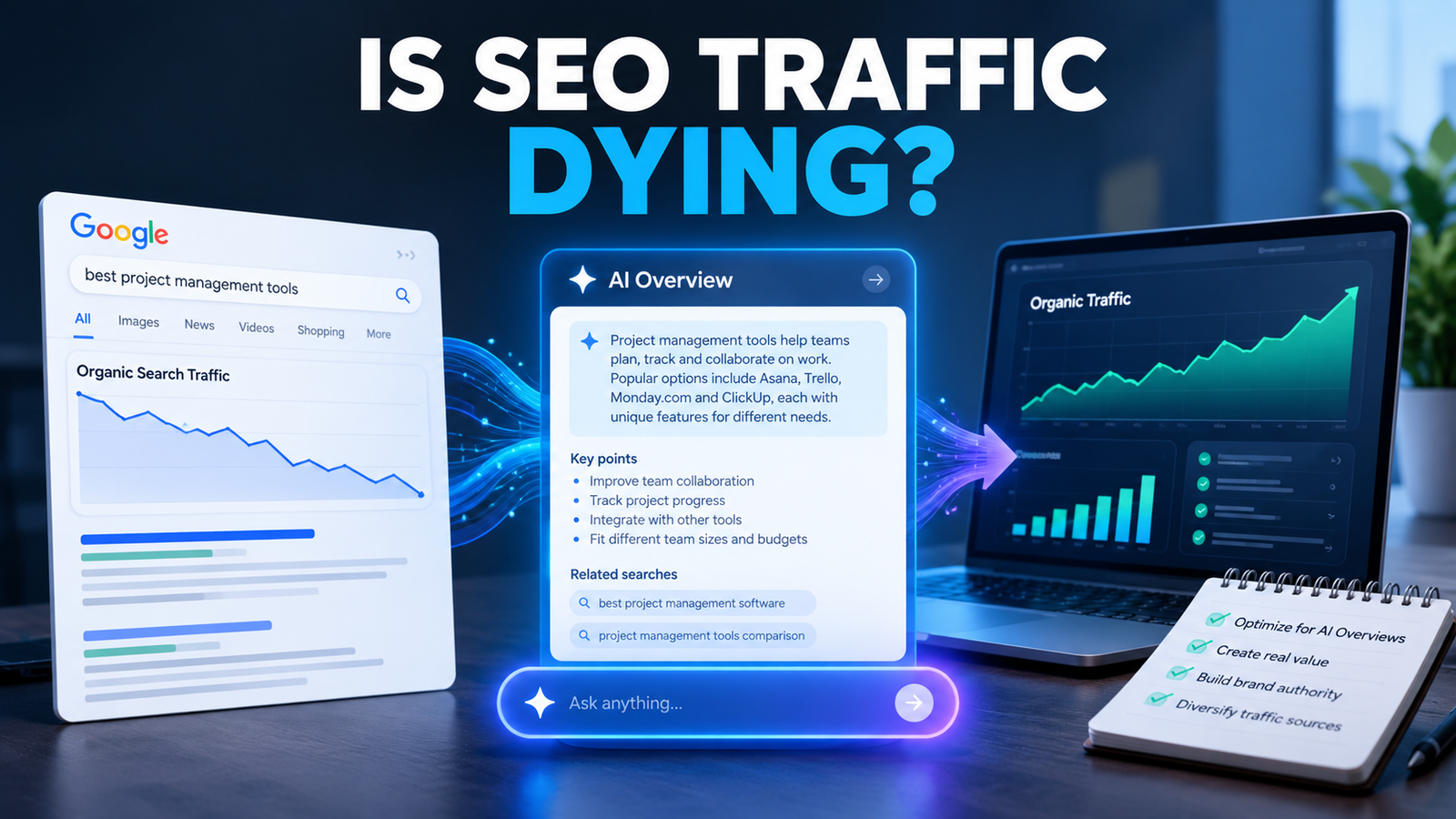
Is SEO Traffic Dying? Real Search Data, AI Overviews and What to Do
Every few months, someone declares search dead. Every few months, a chart appears that makes the claim feel true. In 2026 the chart is real, and so is the confusion around it.
Publishers measured a drop of roughly a third in Google referrals across one year. Controlled experiments show that AI summaries pull clicks away from the pages beneath them. Meanwhile, the new AI channels that were supposed to replace Google still send only a sliver of visits. Both facts sit in the same dataset, and most commentary picks one and ignores the other.
This article does something different. It separates what has been observed from what has been explained, and what has been explained from what has merely been predicted. It compares datasets that measure different things, names their limits, and then turns the evidence into a diagnostic process and a 90-day plan you can run on your own site.
The short answer: SEO is not dying, but the old bargain of “rank, get the click, earn the visit” is weaker for many kinds of content than it was two years ago. The sites that adapt will not be the ones chasing tricks. They will be the ones that measure carefully, publish things that cannot be summarized away, and stop depending on a single channel.
Is SEO Traffic Really Dying in 2026?
No, but “not dying” is not the same as “fine.” Organic search is still the largest measurable source of visits for most websites. What has changed is how evenly that traffic is distributed and how reliably a ranking converts into a click.
What current traffic studies establish
Four things are reasonably well established by published evidence:
- Publisher referrals from Google fell sharply. Chartbeat data reported in the Reuters Institute’s 2026 trends report showed Google search referrals to more than 2,500 publisher sites down 33% globally between November 2024 and November 2025, and down 38% in the United States.
- AI summaries reduce clicks on the queries where they appear. A randomized field experiment published in 2026 found that showing an AI Overview cut outbound organic clicks by roughly 38 to 40% on triggered queries, depending on the version of the paper.
- Zero-click behavior is common. SparkToro’s analysis of Similarweb panel data put the share of US Google searches that ended without a click to the open web at about 68% in early 2026.
- AI platforms are not yet replacing Google as a traffic source. Semrush found AI referral traffic grew about 66% in 2025 but represented only 0.14% of total traffic in its dataset.
What the studies do not establish is equally important. They do not show that every website is losing traffic. They do not prove that AI Overviews are the sole cause of every decline. And they do not predict the future; they describe a past window.
What the Latest Search Traffic Data Shows
A single number cannot describe “search traffic.” Different studies sample different sites, measure different things, and cover different periods. Reading them together is the only honest way to see the shape of the change.
Compare publisher data with broader website datasets
| Dataset | What it measures | Headline finding | Main limitation |
|---|---|---|---|
| Chartbeat via Reuters Institute (2,500+ publisher sites) | Referral traffic to news and media sites, Nov 2024 to Nov 2025 | Google search down 33% globally, 38% in the US; Discover down 21% | Publishers only; skews toward news and lifestyle content |
| Semrush Traffic and Market Toolkit (17 industries, 2025) | Channel mix across a broad site set | Total organic traffic up 2.38%; AI referrals up 66% to 0.14% share | Estimated panel data, not first-party analytics |
| Randomized field experiment (SSRN, 2026) | Click behavior with and without AI Overviews | About 38 to 40% fewer outbound organic clicks on triggered queries | Roughly one thousand desktop Chrome users over two weeks |
| Pew Research panel | Click behavior in real browsing | Organic click rate about 8% with an AI Overview versus 15% without | Panel study; one snapshot in time |
| Seer Interactive (53 brands) | Search Console style CTR across tracked queries | CTR of 0.61% with an AI Overview versus 1.62% without | Brand sample is limited and self-selected |
Read the first two rows side by side and a puzzle appears. Publishers lost a third of their Google referrals, yet Semrush’s broader dataset showed total organic traffic roughly flat to slightly up. These are not contradictory. They are measuring different populations. News and utility sites, which answer questions that a summary can resolve, carry the sharpest losses. A wider mix of commercial, service, and e-commerce sites shows a more stable picture.
Two cautions apply. First, the Reuters Institute report also noted that European publishers had not yet seen the same decline as US ones at the time of writing, so geography matters. Second, publishers surveyed in the same report expected search traffic to fall by around 43% on average over three years. That is a forecast from people worried about their own business, not a measurement. Treat it as sentiment.
Why Organic Search Traffic Is Changing
The change has several layers, and blaming one of them oversimplifies the problem.
AI summaries, changing interfaces, and user behavior
The most visible cause is the answer box that now sits at the top of many results. Google’s AI Overviews and AI Mode compose a response from multiple sources and display links alongside it. Google announced at its 2026 developer event that AI Mode had passed one billion monthly users, which tells you how fast search behavior is moving.
But interface changes are only part of the story. Users are also splitting their discovery across more places: video platforms, social feeds, forums, AI assistants, and newsletters. Some of the traffic that used to arrive through a search click now arrives through a recommendation, a subscription, or a branded query typed after seeing a name elsewhere.
There is also a measurement layer. Analytics tools often cannot attribute AI-influenced visits correctly. A Similarweb panel study of US desktop users found that among visits influenced by an AI recommendation, only a small share came through a direct AI referral, while a larger share arrived through a search, typically a branded query typed afterward. In other words, some of the effect of AI is invisible in referral reports because it surfaces as a later search or as direct traffic.
How AI Overviews Affect Website Clicks
The direction is consistent across studies. The size depends on the method.
Understand query-level differences and limitations
Four independent approaches have landed in the same neighborhood:
- Pew Research observed users clicking an organic result about 8% of the time when an AI Overview appeared, versus 15% when it did not.
- A randomized experiment removed AI Overviews for some users and found that their presence cut outbound organic clicks by roughly 38 to 40%, and raised zero-click searches from 54% to 72%. Removing top-of-page overviews nearly doubled outbound clicks; lower-positioned ones had little effect.
- Seer Interactive measured organic CTR of 0.61% on queries with an AI Overview against 1.62% without.
- Ahrefs reported that the top-ranking result lost about a third of its expected clicks when an overview was present.
Now the limitations. These figures describe queries where an AI Overview actually appeared, not all queries. Overviews show up unevenly: far more often on informational questions than on navigational, local, or transactional searches. A site whose traffic is mostly “what is” and “how to” queries is exposed to a different level of risk than a site whose traffic is mostly branded searches and product comparisons.
There is a second nuance that rarely gets airtime. Seer’s data showed that a cited page on a result with an AI Overview earned around 2.1% CTR, while an uncited page earned about 0.9%, against roughly 3.3% for results with no overview at all. Seer also reported that click-through on overview queries recovered from 1.3% in December 2025 to 2.4% in February 2026. One data point is not a trend, but it is a reminder that the situation is still moving.
What Zero-Click Search Means
When a search answer satisfies a user without a click
A zero-click search is any search that ends without a visit to an external website. That sounds like pure loss, but it covers very different situations.
Some zero-click searches are genuinely satisfied: the weather, a unit conversion, a sports score, the opening hours of a nearby shop. No website was ever going to earn a meaningful visit from these. Others are click-adjacent: the user refines the query, clicks a map result, or opens a Google-owned property. Others are real losses: a user who would have read your guide now reads a summary built partly from it.
The SparkToro analysis noted that categories such as branded searches, local queries, and high-intent transactional searches remain less affected than informational content. That aligns with the experimental evidence. The practical lesson is that “zero-click” is not a verdict on SEO as a whole. It is a warning about one type of page: the informational page whose entire value can be delivered in two sentences.
Why Some Websites Lose More Traffic Than Others
If you run a site that has lost traffic, the most useful question is not “is SEO dead?” but “why did my pages lose, when other sites did not?”
Compare intent, industry, and page type
The Reuters Institute report observed that publishers focused on lifestyle or utility content, such as weather, TV guides, and horoscopes, were more likely to have seen declines. That is consistent with the broader pattern. Vulnerability tends to follow four variables:
- Intent. Informational queries that have a short, definitive answer lose the most. Transactional and navigational queries lose the least.
- Page type. Definition pages, simple how-to pages, listicles of widely known facts, and aggregated summaries are easiest to replace with a generated answer. Original research, tools, calculators, reviews based on testing, and community content are harder.
- Industry. Sectors where information is standardized, such as basic health definitions, finance explainers, and general reference, face heavier summarization than sectors where the product or service itself is the destination.
- Brand strength. Sites with strong branded demand are less dependent on the generic query. People who already know you search for you by name.
When diagnosing a loss, sort your pages by these variables before you draw conclusions. A decline concentrated in a cluster of simple informational pages tells a very different story from a decline spread across product pages, which may point to a technical or ranking problem instead.
Is Traditional SEO Still Relevant?
Yes. This is the least fashionable and most supported conclusion in the data.
Technical foundations, quality, and discoverability
Google’s own guidance, published as a dedicated Search Central guide on generative AI features in May 2026, is direct on this point. It states that its AI features are built on the same core ranking and quality systems as regular Search, that the established best practices continue to apply, and that no special markup, machine-readable files, or extra requirements are needed to appear in AI Overviews or AI Mode. A page must be indexed and eligible to show a snippet in order to be used as a supporting link.
That means the foundation has not moved:
- Crawlability and indexing: pages must be reachable, indexable, and not blocked by robots rules or noindex directives.
- Clear structure: descriptive titles, headings that reflect the page’s content, and internal links that help both users and crawlers find related material.
- Page experience and accessibility: fast, readable, mobile-friendly pages.
- Accurate structured data that matches visible content.
- Up-to-date Merchant Center and Business Profile information for commerce and local sites.
An industry study cited by SEO analysts found that almost all URLs cited in AI Overviews also appear in the top ten organic results. Treat that as supportive rather than conclusive, but it fits what Google says: AI visibility is built on top of ordinary search visibility, not beside it.
SEO vs GEO vs AEO
The acronyms multiplied faster than the evidence. Here is a sober way to hold them.
Clarify the differences without treating them as replacements
- SEO is the practice of making content discoverable and useful in search engines.
- GEO (generative engine optimization) refers to efforts to be included or cited in AI-generated answers.
- AEO (answer engine optimization) refers to structuring content so that it can be selected as the direct answer to a question.
In practice the three overlap heavily. Writing content that answers a question clearly, backing it with verifiable detail, and making it technically accessible helps in all three. Google’s May 2026 guide did not treat GEO or AEO as separate disciplines that replace SEO, and it did not endorse tactics such as creating special files for AI systems.
You can still track AI visibility as its own reporting line. That is measurement, and it is useful. What is not supported is the idea that a bag of GEO tricks can guarantee citations. No credible dataset shows such a guarantee, and any vendor promising one is selling confidence, not evidence.
How to Diagnose an Organic Traffic Decline
Before changing anything, find out what actually changed. Most panic-driven rewrites are fixes to problems that were never diagnosed.
Use Search Console and analytics to isolate changes
Work through this order:
- Confirm the decline is real. Compare the same weekdays across equal periods, adjust for seasonality, and compare year over year rather than only month over month.
- Separate channels. In your analytics tool, view organic search on its own, then isolate Google from other engines.
- Check technical events. Look for indexing drops, robots changes, migrations, template changes, or tracking-tag breakage around the date of the decline.
- Compare against known update windows. Google’s May 2026 core update, for example, began May 21 and was marked complete on June 2. A decline that begins in a window like that points to a ranking evaluation rather than an interface change.
- Split impressions from clicks. This is the single most informative step, and the next section covers it.
- Segment by page and query type using the variables in the earlier section on why some sites lose more.
How to Find Keywords Losing Clicks
Identify changes in impressions, positions, and CTR
In Search Console, export query-level and page-level data for two equal periods: before and after the decline. Compare these four numbers for each query or page: impressions, clicks, average position, and CTR.
Then interpret the pattern:
| Pattern | Likely meaning | Typical response |
|---|---|---|
| Impressions stable, position stable, CTR down | The result page changed; an AI answer or other feature may be absorbing clicks | Improve snippet appeal, add unique value, shift effort to queries where clicks hold |
| Impressions stable, position down | Ranking loss to competitors or an algorithm evaluation | Content and quality review against pages now outranking you |
| Impressions down, position stable | Lower query demand, seasonality, or fewer features showing your result | Check demand trends and query variations |
| Impressions and clicks both down sharply | Indexing, technical, or site-wide quality issue | Technical audit first |
The first row deserves attention because it is the one most associated with AI summaries. Rankings look healthy, but the click-through rate erodes. Keep in mind that Search Console blends AI feature activity into the overall Performance report, so you cannot attribute a CTR drop to AI Overviews with certainty from that report alone. You can, however, identify which queries are affected, and then check the live results page to see whether an overview now appears.
How to Measure AI Search Visibility
Measurement has improved in 2026. It is still incomplete.
Use available Search Console reporting and referral analytics
Search Console. On June 3, 2026, Google launched dedicated Search Generative AI performance reports, with separate views for Search (which covers AI Overviews and AI Mode) and Discover. The reports show impressions, plus breakdowns by page, country, date, and device. Access expanded to more sites later in June. Two details matter. The reports show impressions, not clicks, and the same data remains counted inside the overall Performance report. They are a lens, not a separate traffic source.
Referral analytics. Several analytics tools now group visits from AI assistants into their own channel, and Google Analytics 4 has been reported to add an AI assistant channel in 2026. Even so, the data is partial. Many AI-influenced visits arrive as direct traffic or later as branded searches, as the Similarweb panel study showed. The fix is not to chase precision. It is to track three signals together:
- AI referral visits in analytics, as a floor.
- Branded search impressions and clicks in Search Console, as an indirect signal of awareness.
- Direct traffic trends to key landing pages.
Third-party tools. Citation-tracking tools sample AI answers for sets of prompts. They are useful for comparing yourself to competitors over time but should be treated as sampled estimates.
Keep expectations proportional. In Semrush’s 2025 channel analysis, AI referrals were 0.14% of total traffic, and a separate Semrush analysis of 40 large sites found AI traffic around 0.19% of visits against roughly 20% for organic search. A different benchmark from Conductor put AI referrals just above 1% across ten industries. The gap between those figures is itself instructive: definitions, industries, and samples drive the answer. AI referral traffic is real, growing, and small. Plan around the trend, not the current share.
Why Original Content Matters
Google’s guide placed one recommendation above all others: creating content that people find unique, engaging, and helpful has a greater long-term effect on appearing in AI search than any other suggestion in the guide.
Research, first-hand experience, and distinctive evidence
That advice is not a platitude. It describes a structural change. When a generative system can assemble a competent summary of widely available facts, any page that only restates those facts becomes interchangeable. What cannot be assembled from the existing pile of text is something new:
- Original data. Surveys, benchmarks, tests, and analyses of your own first-party numbers.
- First-hand experience. Photographs, screenshots, measurements, and honest accounts of what happened when you actually used the product or followed the process.
- Expert interpretation. A named author with real credentials explaining why the data means what it means.
- Specific, verifiable detail. Dates, versions, limits, costs, and edge cases that a generic summary leaves out.
- Useful tools. Calculators, templates, checklists, and datasets that people need to use rather than read about.
This is also where trust is earned. Pages that cite their sources, disclose their method, and admit what they do not know are easier for both readers and systems to rely on.
How to Improve Pages for AI Search
There is no secret formula. There is a disciplined checklist drawn from documented guidance.
Apply Google’s documented SEO and quality guidance
- Confirm eligibility. The page must be indexed and snippet-eligible. Do not block it with directives you do not intend.
- Lead with the answer, then add depth. Give the direct answer in the opening lines of a section, then supply the context, evidence, and nuance that a summary would drop.
- Match the full intent. AI features may expand a query into multiple related sub-questions through a technique Google calls query fan-out. Pages that cover the surrounding questions a reader naturally has are better positioned than pages that answer only the narrow phrase.
- Support text with strong media. High-quality images and video can surface in AI features and give you extra ways to appear.
- Keep structured data truthful. It must match the visible text. Do not add markup for content that is not on the page.
- Keep business information current. Merchant Center and Business Profile data feed commerce and local visibility.
- Use clear titles, descriptive headings, and accurate meta descriptions. The basics still do the work.
- Make internal links meaningful. Help crawlers and readers reach your related pages.
- Review preview controls. If you want to limit how your content appears, use documented snippet and robots controls and understand the trade-off, because limiting use may reduce visibility.
- Do not manufacture hacks. Special files for AI systems, keyword-stuffed question blocks, and fake freshness updates are not documented requirements and carry risk.
Google has also noted that clicks from results pages with AI Overviews can be higher quality, with users more likely to spend time on the site. That claim comes from Google itself, and independent confirmation is limited, so treat it as a hypothesis to test with your own engagement data rather than a promise.
How Brand Searches Can Support Traffic
When informational queries soften, a different kind of demand becomes more valuable: people searching for you by name.
Build recognizable expertise and repeat demand
Branded queries are navigational. They are less likely to be answered by a summary because the user wants a specific destination. Branded demand is also a durable asset, because it does not depend on a single page ranking for a single phrase.
Ways to build it, none of which require gaming anything:
- Publish a consistent point of view in a defined niche so readers associate topics with your name.
- Put real, named authors with demonstrable expertise behind your content.
- Earn mentions in places your audience already trusts: communities, newsletters, podcasts, industry publications, and conferences.
- Create reasons to return: a recurring report, a regularly updated tool, a newsletter with original analysis.
- Track branded impressions and clicks in Search Console as a leading indicator of awareness.
Google’s guide acknowledged that its generative features may reflect what is said about products and services across blogs, videos, and forums. Being discussed credibly outside your own site supports visibility inside and outside Google.
How to Diversify Website Traffic
The most reliable lesson from 2025 and 2026 is concentration risk. A business that gets most of its visits from one source on one platform has handed that platform control over its revenue.
Email, social, communities, referrals, and direct visits
Build a portfolio of channels, and give each a job:
- Email. The only audience channel you own. Invite readers to subscribe with something of real value, and measure open and click behavior.
- Search. Keep investing in the queries where clicks still hold: transactional, local, comparison, and navigational.
- Video and audio. Where your topic benefits from demonstration, these formats reach people who never click a blue link.
- Social platforms. Use them for distribution and relationship, not as a sole home. Their reach changes without notice, as the 2025 referral data for different networks showed.
- Communities and forums. Contribute expertise honestly and link only where it is genuinely helpful.
- Partnerships and referrals. Co-created resources, guest contributions, and mentions from adjacent sites bring qualified visitors and strengthen brand signals.
- Direct traffic. Bookmarks, app usage, and returning readers are the strongest sign of a real audience.
The Reuters Institute report found publishers shifting effort toward video, audio, and original reporting while reducing reliance on traditional SEO. Not every site should copy that, but the principle holds: decide which channels you will own, and which you will merely rent.
How to Improve Revenue With Fewer Visits
Traffic is a means. Revenue, leads, subscriptions, and retention are the ends. If clicks are becoming scarcer, each click has to be worth more.
Measure qualified visitors and conversions
Start by changing what you report. Replace sessions as your lead metric with outcomes tied to the business:
- Conversion rate by landing page and by channel.
- Revenue or lead value per organic visit.
- Newsletter signups, demo requests, purchases, or other defined goals.
- Engaged return visits within thirty days.
Then act on what you see:
- Align content with commercial intent. Pages that help someone compare, evaluate, or decide tend to hold clicks better than pages that merely define.
- Strengthen conversion paths. Clear calls to action, relevant internal links, and fast, simple forms.
- Capture the visitor. If someone arrives for an informational answer, offer a logical next step such as a checklist, a template, or a subscription.
- Prune vanity. A page that attracts many low-value visits and no outcomes may be less important than a page with modest traffic and strong conversion.
Some data suggest AI-referred visitors can be more engaged than average, although findings on conversion have been mixed across retail datasets. Test it on your own site instead of assuming.
Which Content Strategies Are Losing Value?
Some approaches that worked in the previous era are now weak. The evidence is consistent with the direction of Google’s guidance, though no single study isolates each tactic.
Evaluate thin, repetitive, and undifferentiated pages
- Commodity answers. Pages that restate what a hundred other pages say, with no new data, example, or insight.
- High-volume, low-value informational pages. Definition-style content written purely to capture a keyword.
- Repetitive programmatic pages. Large sets of near-identical pages differing only by a swapped term or location.
- Mass-produced, unreviewed text. Content produced at scale without human expertise, fact-checking, or a point of view. Google’s guide noted that AI-generated content can rank when it is helpful, so the issue is value, not the tool used to write it.
- Link-first publishing. Content created primarily as a vehicle for placing links rather than serving readers.
- Outdated pages. Stale statistics and obsolete advice that erode trust.
None of this means informational content is worthless. It means informational content must contribute something a summary cannot: depth, evidence, experience, or utility.
How to Audit Existing Content
A content audit is the most productive action for most sites facing decline, because it replaces opinion with a decision for every page.
Refresh, consolidate, improve, or retire pages using evidence
Pull a list of all indexed pages. For each, gather twelve months of clicks, impressions, average position, conversions, backlinks, and last update date. Then assign one of four decisions:
| Decision | When to apply | Action |
|---|---|---|
| Keep | Performing well, accurate, and aligned with goals | Leave alone; monitor |
| Refresh | Good topic and some visibility, but outdated or shallow | Update facts, add original evidence, improve structure, and republish with an honest update date |
| Consolidate | Several weak pages covering the same intent | Merge into one strong page and redirect the others |
| Retire | No traffic, no links, no conversions, no strategic purpose | Remove or noindex, with a redirect where a relevant destination exists |
A few rules keep the audit honest. Do not delete pages simply because traffic fell; check whether the page still supports conversions or brand value. Do not change a publication date unless the content has meaningfully changed. And record each decision so that you can compare results later.
A Practical 90-Day SEO Traffic Plan
This plan assumes a site that has seen declining or stagnant organic results and wants a disciplined response rather than a panic. Adjust the scale to the size of your team.
Baseline, prioritize, test, and measure results
Days 1 to 30: Baseline and diagnose
- Export twelve to sixteen months of Search Console data by query and page, and match it to analytics conversions.
- Check for technical issues: indexing coverage, crawl errors, robots directives, canonical problems, and speed.
- Segment pages by intent, page type, and topic cluster.
- Identify queries where impressions are steady but CTR has fallen, and check the live results to see whether an AI feature appears.
- Open the Generative AI performance report if available, and record baseline impressions by page.
- Set up channel groupings for AI referrals and branded search tracking.
- Define three to five business outcome metrics.
Days 31 to 60: Prioritize and act
- Run the content audit and assign keep, refresh, consolidate, or retire to each page.
- Refresh the ten to twenty pages with the highest potential, adding original data, first-hand evidence, named expert review, and clearer structure.
- Consolidate overlapping pages and implement redirects carefully.
- Fix the technical issues found in the first phase.
- Launch or improve an email capture path on your top informational pages.
- Start one original-research asset: a survey, benchmark, or analysis of your own data.
Days 61 to 90: Test, expand, and measure
- Publish the original-research asset and promote it through email, communities, and partners.
- Compare refreshed pages to a control group of unrefreshed pages on impressions, CTR, position, and conversions.
- Review branded search growth and AI feature impressions against baseline.
- Test one new channel, such as video or a partner newsletter, with a defined success metric.
- Document what worked, retire what did not, and set the next quarter’s priorities.
| Phase | Primary goal | Key output |
|---|---|---|
| Days 1 to 30 | Understand what actually changed | Diagnosis and baseline report |
| Days 31 to 60 | Improve and consolidate | Audited, refreshed, and fixed content set |
| Days 61 to 90 | Test and learn | Measured results and next-quarter roadmap |
Be patient with measurement. Refreshed pages often need several weeks for search engines to reprocess them, and any conclusions drawn from the first two weeks are likely to be noise. No plan can guarantee recovery, because some of the lost clicks have moved to the results page itself and will not return.
Frequently Asked Questions
Traffic recovery, AI search, and the future of SEO
Is SEO traffic dying? Organic traffic patterns are changing, and some content types have lost substantial clicks, especially informational queries answered by AI summaries. But organic search remains a major measurable source of visits for most sites, and broader datasets show total organic traffic roughly stable in 2025. SEO as a discipline is changing, not disappearing.
How much traffic have publishers lost? Chartbeat data reported by the Reuters Institute showed Google search referrals to more than 2,500 publisher sites down about 33% globally between November 2024 and November 2025, and about 38% in the United States. Those figures describe publishers and should not be applied to every website.
Do AI Overviews reduce clicks? On the queries where they appear, yes. Multiple studies, including a randomized field experiment, found lower click rates, with reductions in the range of roughly one third to more than half depending on method and query type. The overall effect on a given site depends on how many of its queries trigger an overview.
Can I recover lost organic traffic? Sometimes. If the loss came from a technical fault, a ranking change, or outdated content, recovery is realistic. If it came from clicks being absorbed by an answer on the results page, you may recover value by shifting to queries where clicks hold, improving conversion, and building other channels, rather than restoring the old click volume.
Is AI search replacing Google? Not in referral terms so far. Semrush measured AI referrals at about 0.14% of total traffic in its 2025 dataset, and other benchmarks put the share near one percent. AI tools may influence decisions that later appear as branded or direct visits, which standard reports do not capture well.
Should I optimize for GEO or AEO? Treat them as extensions of good SEO, not replacements. Google’s own guidance says its generative features use the same ranking and quality systems as standard Search and does not require special files or markup. Focus on indexable, original, useful content and on measuring AI visibility where tools allow.
How do I track AI visibility in Search Console? Use the Search Generative AI performance reports that Google launched on June 3, 2026, if they are available for your property. They show impressions in AI Overviews, AI Mode, and Discover by page, country, date, and device. They do not report clicks separately, and the same data remains inside the main Performance report.
What content is most likely to keep earning clicks? Content with something a summary cannot supply: original research, first-hand testing, expert analysis, tools, and detailed comparisons. Navigational, local, and transactional queries also tend to be less affected than simple informational ones.
How long does it take to see results from a content refresh? Often several weeks, and sometimes longer for competitive topics. Compare refreshed pages against similar unrefreshed pages so you can separate the effect of your work from wider market movement.
What is the single most important step to take now? Measure properly. Separate impressions from clicks, segment by intent, tie traffic to conversions, and decide page by page what to improve, merge, or retire. Everything else depends on knowing what actually changed.
The Bottom Line
The honest verdict on “is SEO traffic dying” is more useful than either extreme. Clicks from informational searches are being absorbed by answers on the results page, and the data from publishers, panels, and experiments agrees on that. Yet search is still where most measurable discovery happens, the new AI channels are tiny as traffic sources, and Google says the fundamentals still decide who gets surfaced.
The winners from here will do four unglamorous things well. They will diagnose before they react. They will publish work that carries evidence, experience, and a point of view. They will measure outcomes rather than sessions. And they will build audiences they own, so that no single interface change can rewrite their business overnight.
Sources
- Reuters Institute, Journalism, Media and Technology Trends and Predictions 2026
- Press Gazette: Global publisher Google traffic dropped by a third in 2025
- Semrush: Traffic Channel Mix Study
- Search Engine Journal: Study Confirms Google AI Overviews Cut Organic Clicks 38%
- Search Engine Land: Google AI Overviews CTR shows early signs of recovery
- SparkToro zero-click data, via TechWyse
- Search Engine Land: Conductor benchmark, AI sends 1% of website traffic
- Google Search Central: AI features and your website
- Google Search Central: Optimizing your website for generative AI features
- Google Search Central Blog: Search Generative AI performance reports
- PPC Land: AI referral traffic explained