
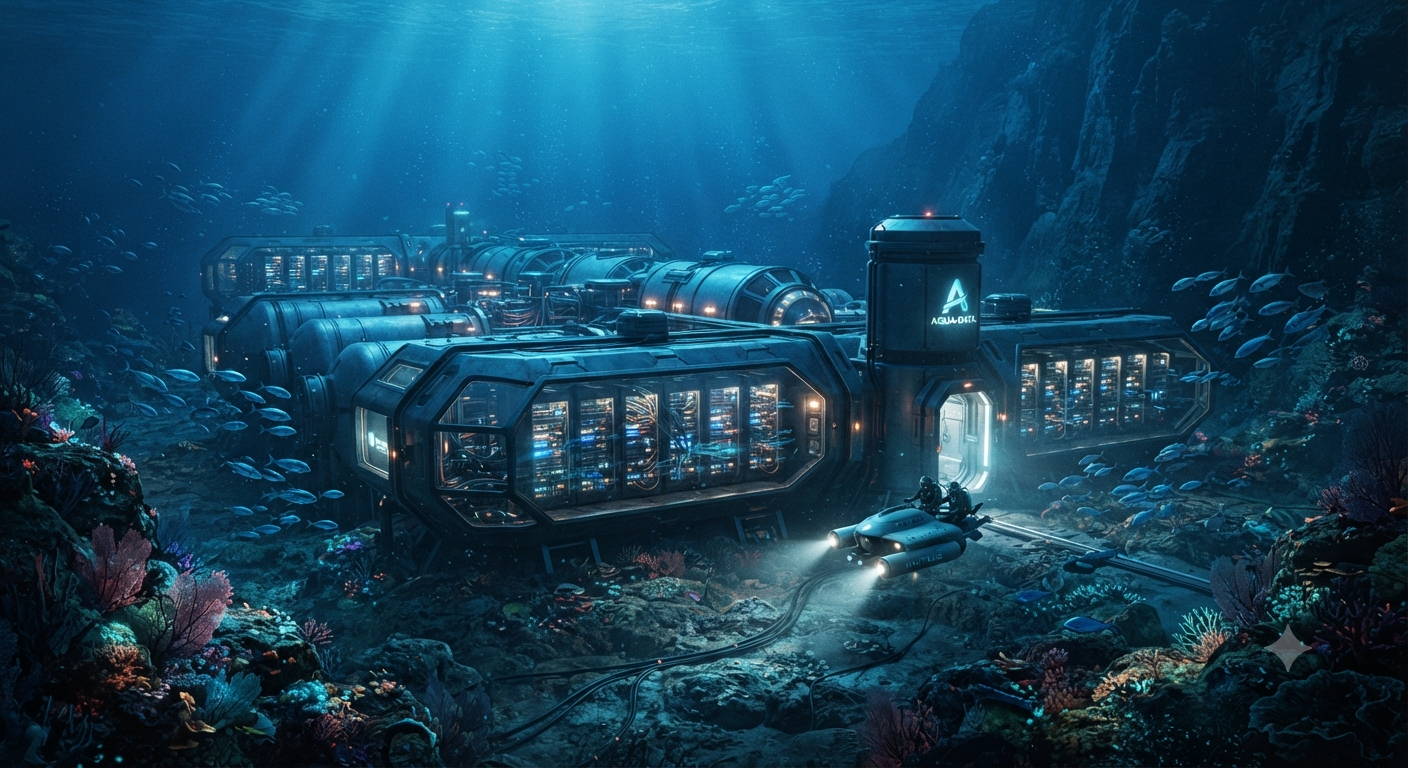
Underwater Data Centers: How They Work, Benefits, Challenges, and the Future
Meta Description: Discover how underwater data centers work, why companies are exploring them, their advantages, challenges, and whether submerged data centers are the future of cloud computing.
Underwater Data Centers: A Complete Guide
Data centers consume enormous amounts of electricity and generate large quantities of heat. Cooling this equipment is one of the biggest operating expenses for cloud providers. To solve this challenge, engineers have developed an innovative concept: underwater data centers.
Instead of building facilities on land, underwater data centers are sealed inside waterproof containers and placed on the ocean floor. The surrounding seawater naturally removes heat, reducing cooling costs and improving energy efficiency.
«”The ocean can act as one of the world’s largest natural cooling systems for modern data centers.”»
What Is an Underwater Data Center?
An underwater data center is a sealed, waterproof container filled with servers, networking equipment, storage systems, and power infrastructure.
The entire module is submerged beneath the ocean, lake, or sea. Fiber-optic cables connect the facility to land, allowing it to deliver cloud services just like a traditional data center.
These facilities are designed to operate for years without requiring human access.
Why Build Data Centers Underwater?
Traditional data centers require expensive cooling systems that consume large amounts of electricity.
Water naturally absorbs heat much better than air. By placing servers underwater, operators can use the surrounding ocean to cool equipment more efficiently.
This approach can reduce operating costs while improving energy efficiency.
How Underwater Data Centers Work
The operating process is surprisingly simple.
Step 1
Servers are installed inside a sealed steel pressure vessel.
Step 2
The module is transported by ship to its deployment location.
Step 3
It is lowered to the seabed using cranes and specialized equipment.
Step 4
Power and fiber-optic cables connect the module to the shore.
Step 5
The data center operates remotely with continuous monitoring.
Most maintenance is performed after the module is recovered from the ocean.
Main Components
Component| Purpose
Server Racks| Process computing workloads
Storage Systems| Store customer data
Fiber-Optic Cables| High-speed network connection
Power Supply| Delivers electricity
Heat Exchanger| Transfers heat to seawater
Monitoring Sensors| Track temperature and equipment health
Pressure Vessel| Protects equipment from seawater
Each component is designed for long-term underwater operation.
Benefits of Underwater Data Centers
There are several reasons why technology companies are interested in this concept.
Lower Cooling Costs
Ocean water provides continuous natural cooling.
This greatly reduces the need for energy-intensive air conditioning systems.
Better Energy Efficiency
Cooling represents a significant portion of a data center’s electricity use.
Natural cooling improves overall energy efficiency.
Less Land Required
Large land-based campuses require significant real estate.
Underwater facilities occupy very little valuable land.
Faster Access for Coastal Cities
Nearly half of the world’s population lives close to coastlines.
Placing data centers offshore can reduce network latency for nearby users.
Lower Carbon Emissions
Natural cooling decreases electricity consumption, helping reduce greenhouse gas emissions.
Challenges of Underwater Data Centers
Although promising, underwater facilities also face important challenges.
Maintenance
Technicians cannot simply walk into the facility.
If major repairs are required, the entire module may need to be recovered.
Installation Costs
Building waterproof pressure vessels and deploying them underwater requires specialized equipment.
Initial investment is high.
Corrosion
Saltwater is highly corrosive.
Advanced materials and protective coatings are essential for long-term durability.
Limited Expansion
Unlike traditional buildings, underwater modules cannot be expanded easily after deployment.
Cooling Comparison
Cooling Method| Energy Efficiency| Maintenance
Air Cooling| Moderate| Easy
Liquid Cooling| High| Moderate
Underwater Cooling| Very High| Difficult
Underwater cooling provides excellent thermal performance but increases maintenance complexity.
Are Underwater Data Centers Reliable?
Yes, when properly engineered.
Because underwater modules remain sealed, they experience less dust, fewer temperature fluctuations, and minimal human interference.
Some studies have shown lower hardware failure rates compared to traditional facilities.
However, reliability depends on high-quality engineering and continuous remote monitoring.
Environmental Impact
Engineers carefully evaluate environmental effects before deployment.
Potential concerns include:
- Local temperature changes
- Marine ecosystems
- Seafloor disturbance
- Cable installation
- Long-term monitoring
Proper site selection helps minimize environmental impact.
Who Is Developing Underwater Data Centers?
Several technology companies and research organizations have explored underwater data centers.
Pilot projects have demonstrated that submerged facilities can successfully operate for multiple years while providing cloud computing services.
Interest continues to grow as organizations search for more sustainable infrastructure.
Future Technologies
Future underwater data centers may include:
- AI-powered monitoring systems
- Advanced liquid cooling
- Renewable offshore energy
- Floating solar farms
- Offshore wind integration
- Autonomous underwater maintenance robots
- Modular expansion systems
These innovations could make underwater computing even more practical.
Underwater vs Traditional Data Centers
Feature| Underwater| Traditional
Cooling| Natural Seawater| Air or Liquid
Land Requirement| Very Low| High
Energy Efficiency| Excellent| Good
Maintenance| Difficult| Easy
Construction Cost| Higher| Lower
Expansion| Limited| Flexible
Each design offers different advantages depending on business needs.
Best Practices
Organizations considering underwater deployment should:
- Select environmentally suitable locations.
- Use corrosion-resistant materials.
- Monitor systems remotely.
- Build redundant network connections.
- Integrate renewable energy where possible.
- Perform extensive reliability testing.
- Develop recovery and maintenance plans.
These practices improve long-term operational success.
Frequently Asked Questions
What is an underwater data center?
It is a waterproof server facility installed beneath the ocean or another body of water that uses natural cooling to improve efficiency.
Why are underwater data centers built?
They reduce cooling costs, improve energy efficiency, and require less land than traditional facilities.
Are underwater data centers safe?
Yes. They are designed with sealed pressure vessels, remote monitoring, and multiple safety systems to protect equipment.
Can technicians repair underwater servers?
Routine maintenance is performed remotely. Major repairs usually require recovering the module to the surface.
Do underwater data centers use seawater inside the servers?
No. Seawater remains outside the sealed container and cools the enclosure through heat exchange.
Are underwater data centers the future?
They have strong potential for specific applications, especially in coastal regions. However, they are likely to complement rather than replace traditional data centers.
Conclusion
Underwater data centers represent one of the most innovative developments in modern cloud infrastructure. By using the ocean as a natural cooling system, these facilities can improve energy efficiency, reduce land requirements, and lower operating costs.
Although challenges such as maintenance, installation costs, and corrosion remain, advances in engineering and remote monitoring continue to make underwater deployments more practical. As demand for sustainable computing grows, underwater data centers could become an important part of the future digital infrastructure, particularly for organizations seeking greener and more efficient ways to support cloud and AI workloads.


Why are not the pages Interlinked?