Legacy SEO suites like Semrush and Ahrefs run around $140 a month, and they still make you click through dashboards to get answers. A newer category of tools skips that step: MCP servers that let you run SEO research directly inside Claude, Cursor, and ChatGPT. Two names come up most often in that category: OpenRush and OpenSEO.
They solve overlapping problems in very different ways. This comparison breaks down setup, pricing, data scope, and workflow so you can pick the right one without testing both.
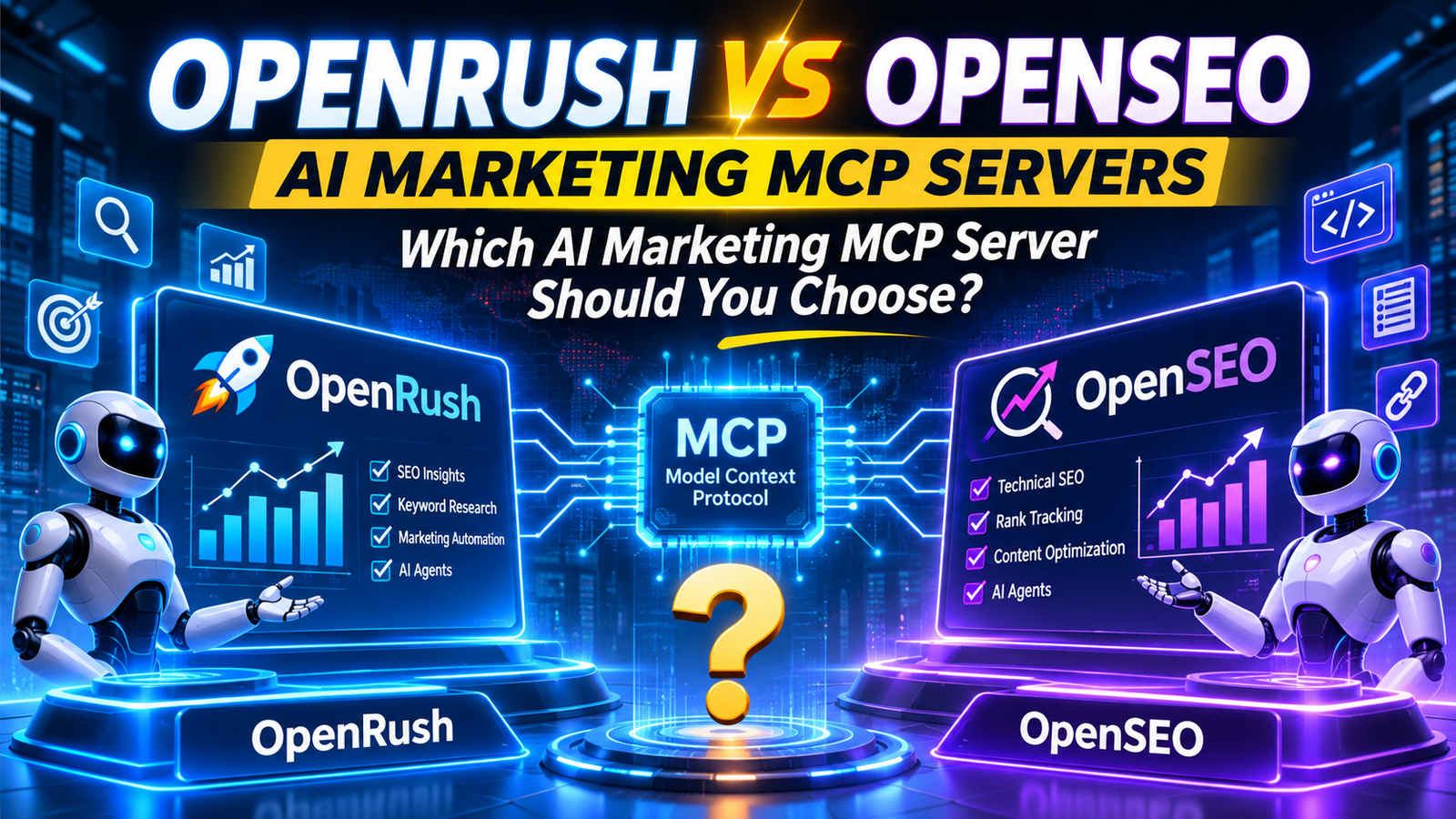
Quick answer: OpenRush is a hosted, multi-channel marketing data layer built for AI agents and workflow automation, covering SEO, paid ads, and ecommerce. OpenSEO is an open-source, MIT-licensed SEO workspace with a full web dashboard and an MCP server, powered by DataForSEO.
Quick Verdict
- Pick OpenRush if you want zero-maintenance setup, run paid ads or ecommerce next to SEO, or build automations in n8n or Zapier.
- Pick OpenSEO if you want a self-hostable, open-source tool with a visual dashboard and raw DataForSEO API pricing.
OpenRush vs. OpenSEO at a Glance
| Feature / Criteria | OpenRush | OpenSEO |
|---|---|---|
| Core Model | Pure API and MCP data layer for AI agents | Open-source web dashboard plus MCP server |
| Open Source / Self-Hosting | Closed, hosted cloud only | Yes (MIT license, via Docker or Cloudflare) |
| Web UI / Dashboard | No traditional SEO UI (agent-first) | Yes, full project UI for rank tracking and audits |
| Pricing Structure | Usage-based credits (about $10 per 1,000 credits) | Free self-hosted (plus DataForSEO API costs) or $10/month hosted plus usage |
| Data Integrations | GSC, GA4, Google Ads, Meta Ads, Shopify, HubSpot, WordPress | Google Search Console, GA4, DataForSEO |
| AI Agent Support | Claude, ChatGPT, Cursor, Perplexity, n8n, Zapier | Claude, ChatGPT, Cursor, Codex, OpenClaw |
What Is OpenRush?
OpenRush is a headless marketing data layer. It has no dashboard to browse; it exists so that AI agents and automation tools can pull marketing data on demand. The platform advertises 8B+ keywords and 1.3B+ websites, refreshed daily.
OpenRush Strengths
- Broad marketing stack: It goes beyond organic SEO. Meta Ads, Google Ads, Shopify, and HubSpot connect to the same layer, so an agent can compare paid and organic return in a single conversation.
- Automation ready: It works inside no-code and low-code tools such as n8n, Zapier, and Make, alongside coding agents.
- Zero setup overhead: There are no API keys to chain together and nothing to host. Add one connector and start prompting.
OpenRush Limitations
- No visual dashboard for browsing reports by hand.
- Closed-source infrastructure, so you cannot self-host or audit it.
What Is OpenSEO?
OpenSEO is an open-source alternative to Semrush and Ahrefs. It pairs a clean web interface with more than 80 MCP tools, so the same data is available to you in a browser and to your AI agent in chat. For a deeper look, read our full OpenSEO review.
OpenSEO Strengths
- True ownership and self-hosting: Deploy it free via Docker or Cloudflare and pay DataForSEO directly at wholesale API rates.
- Hybrid workflow (UI plus agent): Your agent can save keyword clusters and rank trackers straight into the OpenSEO dashboard, where you can verify the data visually.
- AI visibility tracking: Built-in tracking shows how often LLMs mention your brand.
OpenSEO Limitations
- Focused strictly on SEO and GEO. There are no Meta Ads, Shopify, or HubSpot connectors.
- Self-hosting means managing your own DataForSEO key.
Deep-Dive Comparison Across 4 Key Factors
1. Setup and Developer Experience
OpenRush is plug-and-play. You add its hosted connector to your client and start asking questions. OpenSEO offers two paths: an OAuth-based hosted endpoint at https://app.openseo.so/mcp, or a self-hosted Docker deployment where you supply your own DataForSEO credentials.
In clients like Cursor or Claude Code, a remote MCP entry is short. A typical config for the OpenSEO hosted endpoint looks like this:
{
  "mcpServers": {
    "openseo": {
      "url": "https://app.openseo.so/mcp"
    }
  }
}
The exact key names vary slightly between clients, so check your client’s MCP documentation. OpenRush follows the same pattern: one remote connector, authorized once.
2. Pricing and Cost Efficiency
OpenRush charges through credit packs, at roughly $10 per 1,000 credits. You pay for what your agent consumes and nothing else.
OpenSEO has two tiers. Self-hosting costs $0 for the software, and you pay DataForSEO directly. The hosted tier is $10 per month and adds a transparent markup of about 28% over DataForSEO’s rates.
- Solo blogger: Self-hosted OpenSEO is hard to beat on price if you are comfortable with Docker. The hosted tier is the easier route at a small premium.
- Agency or multi-channel team: OpenRush’s credits can replace several separate subscriptions, since SEO, ads, and ecommerce data sit behind one connector.
3. Data Scope: Pure SEO vs. Full-Funnel Marketing
OpenSEO is stronger for dedicated SEO work: daily rank tracking, Lighthouse site audits, and an AI prompt explorer all live inside the same workspace.
OpenRush wins when you want one agent managing ads, ecommerce, and CRM data together. Asking “which blog posts drive Shopify revenue, and how does that compare with my Meta Ads spend?” is a question OpenSEO cannot answer, because it has no connectors for those platforms.
4. Visual Verification vs. Headless Agents
AI hallucination is the most common complaint about MCP-based research. OpenSEO addresses it directly: you can open a link and see the agent’s research inside a real interface, with the underlying keywords, rankings, and audit results on screen.
OpenRush keeps everything inside your chat or automation pipeline. That is faster for repeatable workflows, but you rely on the agent’s summary unless you ask it to show the raw data.
Final Verdict: Which One Should You Pick?
Choose OpenRush if:
- You want a zero-maintenance setup.
- You run paid ads or ecommerce alongside SEO.
- You build automated workflows in n8n or Zapier.
Choose OpenSEO if:
- You want an open-source tool you can self-host.
- You prefer a visual dashboard for rank tracking and site audits.
- You want to pay raw DataForSEO API rates.
The two tools are not mutually exclusive. Some teams use OpenSEO for deep, verifiable keyword and audit work, and OpenRush for cross-channel reporting inside automations.
Frequently Asked Questions
Can I use OpenRush and OpenSEO with Claude Code and Cursor?
Yes. Both support MCP natively and work with Claude, Cursor, and ChatGPT. OpenRush also lists Perplexity, n8n, and Zapier, while OpenSEO lists Codex and OpenClaw.
Which is cheaper, OpenRush or OpenSEO?
Self-hosted OpenSEO is the cheapest option, since you pay only wholesale DataForSEO rates. OpenSEO’s hosted tier costs $10 per month plus usage. OpenRush is pay-as-you-go at roughly $10 per 1,000 credits, with no monthly fee.
Do either of these replace Ahrefs or Semrush completely?
Not completely. They cover about 80% of daily workflows, including keyword and SERP research, very well. Legacy tools still hold deeper multi-year backlink indexes, so heavy link-building analysis may still need one of them.
Which one is better for AI visibility tracking?
OpenSEO includes built-in tracking for how often LLMs mention your brand. OpenRush focuses on broader marketing data rather than a dedicated visibility tracker.