
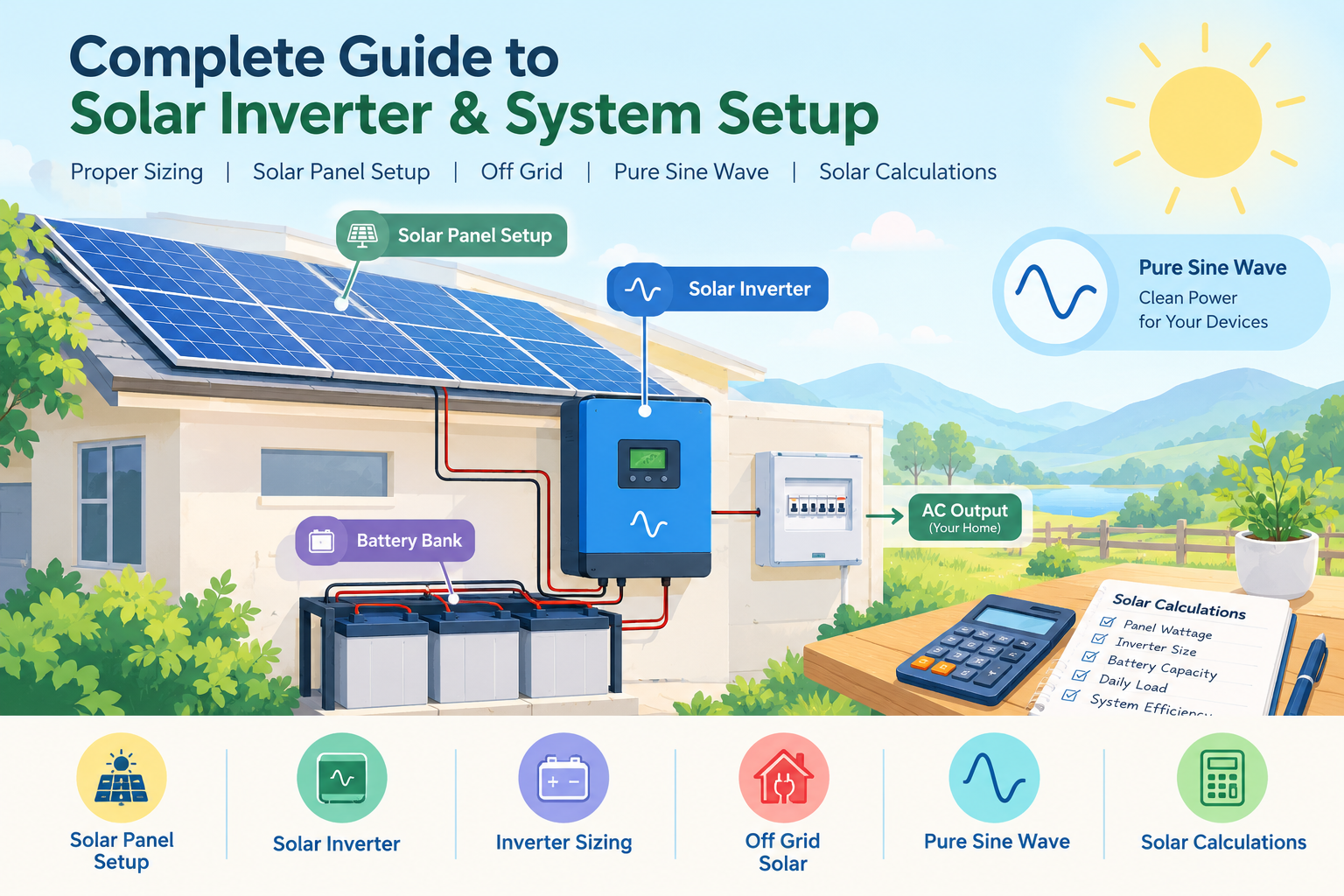
What Size Solar Inverter Do I Need? My Field-Tested Sizing Guide
To determine what size solar inverter you need, calculate your total simultaneous running wattage and add the highest appliance starting surge. Match this combined peak load to a pure sine wave inverter rated 20% to 25% higher than your maximum array capacity, typically requiring a 3kW to 6kW inverter for standard residential setups.
When I first stepped into solar installation work, sizing an inverter felt like guessing a moving target. Most folks assume a 5kW panel array automatically needs a 5kW inverter, but real-world electrical loads don’t work that simply. After testing dozens of off-grid and hybrid installations, I learned that sizing your inverter correctly depends on your continuous running watts and inductive motor surges rather than panel power alone.
How to Calculate Your Exact Solar Inverter Size
To figure out your required inverter size, you must list every electrical appliance you intend to power at the same time. You simply add up their running wattages and then locate the single appliance with the largest starting surge.
I always recommend building a quick load worksheet before buying any gear. If your total simultaneous load comes out to 3,200 Watts, a 4,000-Watt continuous-rated inverter provides the safety buffer you need.
| Appliance Load Type | Running Power (Watts) | Starting Surge (Watts) | Recommended Safety Margin |
|---|---|---|---|
| Refrigerator & Freezer | 200W | 1,200W | 25% Surge Buffer |
| 1 HP Water Pump | 800W | 2,400W | Use Dedicated VFD / Drive |
| LED Lighting & Electronics | 300W | 300W | Standard Continuous |
| 1.5 Ton Inverter AC | 1,500W | 2,500W | High Continuous Capacity |
“Sizing an inverter isn’t just about matching nameplate numbers; it’s about giving your system room to breathe during sudden electrical spikes.” — Field Installation Note
Continuous vs. Surge Watts: What Your Inverter Needs to Handle
Every electrical device requires continuous watts to keep running, but motorized appliances demand massive starting surges. When an electric motor turns on, it draws up to three times its normal running current for a few split seconds.
If your inverter cannot handle this sudden inrush current, its internal protection circuit will trip immediately. I always select pure sine wave units that boast a surge rating equal to at least twice their continuous capacity.
Understanding the DC-to-AC Inverter Sizing Ratio
In modern solar engineering, matching your solar array to your inverter involves looking at the DC-to-AC ratio. Installing an inverter that is slightly smaller than your total solar panel capacity—known as oversizing the array—is a common industry strategy.
A DC-to-AC ratio between 1.15 and 1.25 allows your system to produce optimal power during morning and late afternoon hours. Since panels rarely hit 100% of their factory rating due to heat losses, a 5kW panel array pairs exceptionally well with a 4kW or 5kW inverter.
Undersizing vs. Oversizing Your Solar Inverter: Key Trade-Offs
Choosing whether to undersize or oversize your inverter comes down to your budget and expansion plans. Undersizing the inverter slightly lowers your upfront hardware costs and keeps the inverter operating at peak efficiency during lower light periods.
Oversizing the inverter costs a bit more upfront, but it gives you total freedom to add more solar panels or battery storage later. In my own setups, I prefer choosing a slightly larger inverter upfront to avoid expensive teardowns down the road.
Sizing an Inverter for a 5,000-Watt Solar Panel Array
A standard 5,000-Watt (5kW) solar array typically generates between 3,800W and 4,300W of real-world power under summer heat. For a grid-tied residential setup, a 4kW to 5kW single-phase string inverter performs reliably.
If you are running an off-grid system with heavy household appliances, pair that 5kW array with a 6kW hybrid inverter. This extra headroom easily handles sudden appliance startup spikes without shutting down your power supply.
Why Pure Sine Wave Inverters Are Essential for Sensitive Electronics
Modified sine wave inverters are cheaper, but they deliver choppy block voltage waves that overheat motors and create buzzing noises in audio gear. Modern household appliances require clean, stable electricity to operate safely.
Pure sine wave inverters produce smooth utility-grade electricity that protects sensitive microprocessors, laptop chargers, and variable-speed air conditioners. I never install modified sine wave units on residential properties anymore.
Frequently Asked Questions
Can my solar inverter be larger than my solar panel array?
Yes, your solar inverter can be larger than your solar panel array without damaging your equipment. A larger inverter simply operates at a lower workload until you add more PV panels to your array.
What size inverter do I need to run a 1 HP water pump?
A 1 HP water pump requires roughly 800 running watts, but its starting surge can reach 2,400 watts. You should use a pure sine wave inverter rated for at least 2,500W to 3,000W surge capacity or a dedicated solar pump drive.
Is a 3kW inverter enough to power an off-grid house?
A 3kW inverter can power basic off-grid loads like LED lights, televisions, small refrigerators, and fans simultaneously. However, if you plan to run heavy items like water heaters or air conditioners, you will need a 5kW or larger system.
Future Thought & Further Reading
Looking ahead, smart hybrid inverters equipped with AI load management will automatically balance solar output, grid pricing, and battery backup needs in real time. As residential electrification grows, choosing an inverter with modular expansion ports ensures your home stays ready for future EV chargers and heat pumps.
For further reading on off-grid design and code compliance, explore the National Electrical Code (NEC) Article 690 standards for PV system interconnections and inspect manufacturer spec sheets for exact thermal derating curves.





One Comment