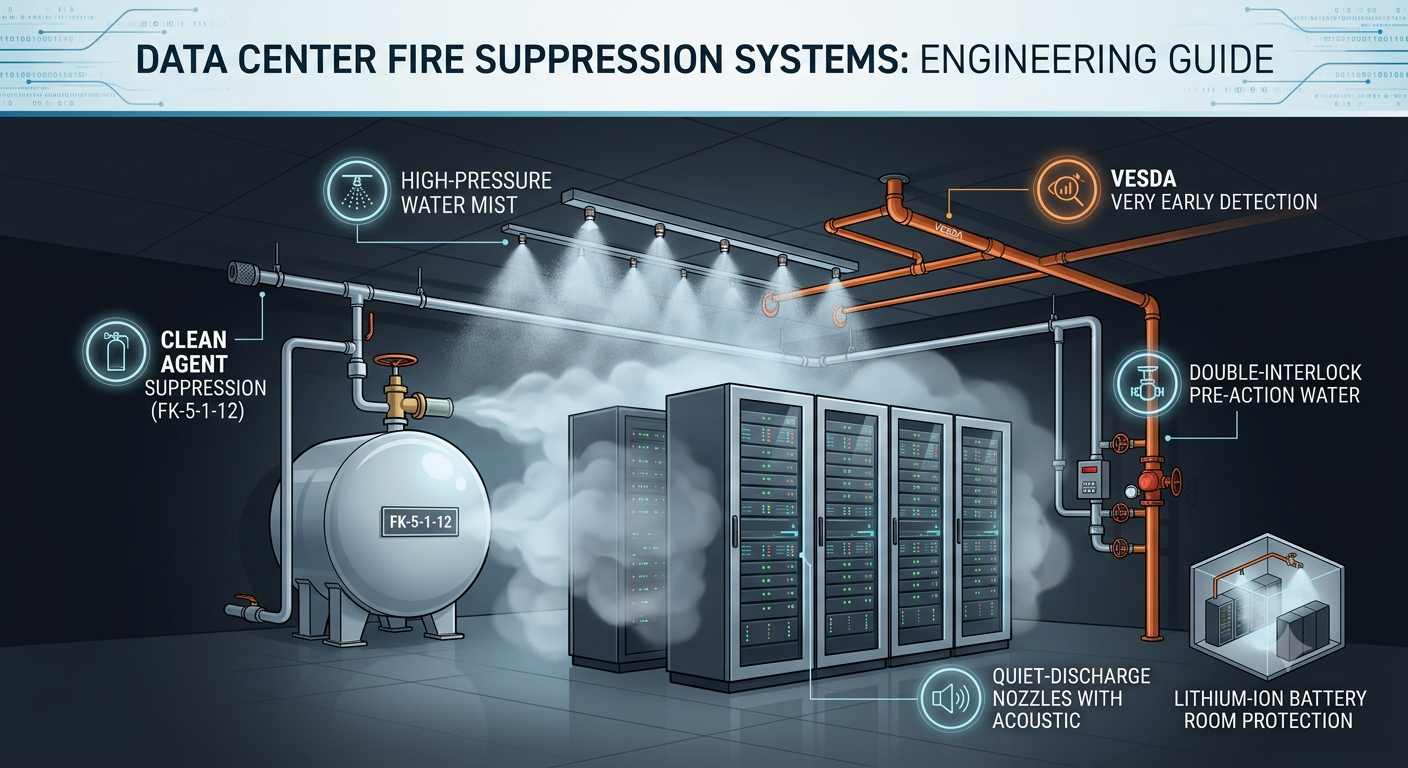
Data Center Fire Suppression Systems: Engineering Guide for Mission-Critical Facilities
Data Center Fire Suppression Systems: Engineering Guide for Mission-Critical Facilities
During commissioning of a Tier IV enterprise data hall in northern Virginia, an unexpected secondary zone trip triggered an inert gas discharge drill across four server aisles. While the fire alarm control panel executed its sequence flawlessly, the sheer acoustic shockwave from legacy high-velocity discharge nozzles rattled spinning hard drives across adjacent test racks, resulting in immediate track-positioning errors and disk read failures. That operational event cemented a vital engineering principle: selecting and designing data center fire suppression systems is no longer just about putting out open flames. It requires a precise balance of rapid fire extinguishment, zero collateral equipment damage, acoustic dampening, and regulatory compliance.
Modern mission-critical environments house extraordinary power densities, with AI server racks exceeding 60 kW to 100 kW per cabinet alongside adjacent Lithium Iron Phosphate (LFP) battery energy storage rooms. Protecting these multi-million-dollar assets requires an engineered, multi-layered strategy that suppresses thermal events in seconds without leaving chemical residues or soaking active electronics. Understanding the mechanics of gaseous clean agents, high-pressure water mist, very early smoke detection, and acoustic nozzle dampening is critical to maintaining continuous business operations.
Core Architectural Mechanisms of Data Center Fire Suppression Systems
Mission-critical fire protection relies on a layered defense matrix that segregates facility zones based on risk, occupant safety, and asset vulnerability. Rather than relying on a single mechanical mechanism, engineers deploy integrated detection and suppression solutions engineered specifically for IT white space, power distribution galleries, and energy storage rooms.
The primary objective of data center fire suppression systems is to extinguish Class A (surface combustibles like cable jackets) and Class C (energized electrical gear) hazards before open flames can trigger building-level structural sprinklers. System selection dictates total installation capex, room sealing parameters, structural venting loads, and long-term facility maintenance.
| Suppression Technology | Extinguishing Mechanism | Residue / Post-Discharge Cleanup | Primary White Space Suitability | Refill / Lifecycle Cost |
|---|---|---|---|---|
| Synthetic Clean Agent (FK-5-1-12) | Thermal heat absorption (chemical) | Zero residue (gas vaporization) | Optimal (fast discharge <10s) | Moderate to High |
| Inert Gas (IG-541, IG-55, IG-100) | Oxygen displacement (down to 12–14%) | Zero residue (natural atmospheric gases) | Optimal (zero GWP / atmospheric safe) | Low agent cost (higher footprint) |
| Double-Interlock Pre-Action Water | Direct thermal cooling and saturation | High (water cleanup and electronic loss) | Secondary backup layer only | Low initial capex |
| High-Pressure Water Mist | Micro-droplet heat flash / localized inerting | Minimal localized moisture | Selective white space / generator halls | Moderate |
Gaseous Clean Agents: Synthetic Chemicals vs. Inert Gases
Clean agents remain the gold standard for server room white space because they are electrically non-conductive, non-corrosive, and leave no residue upon discharge. However, environmental regulations and the global phaseout of legacy fluorinated compounds have driven substantial shifts in agent selection.
Synthetic Halocarbon Clean Agents
Modern synthetic systems utilize fluorinated ketones such as FK-5-1-12 (commercially known as alternatives to phased-out compounds). These agents are stored as liquids under nitrogen pressurization and vaporize instantly upon nozzle release. They extinguish fires primarily via rapid heat absorption at the molecular level, interrupting the chemical chain reaction of combustion within 10 seconds. Their primary engineering benefit is space efficiency, requiring a minimal cylinder footprint in dedicated storage closets.
Natural Inert Gas Mixtures
Inert gas systems deploy atmospheric gases such as Argon (IG-01), Nitrogen (IG-100), or blended formulations like Inergen (IG-541: 52% N2, 40% Ar, 8% CO2) and IG-55 (50% N2, 50% Ar). These systems suppress fire by reducing oxygen levels in the room from 21% down to approximately 12% to 14%—a concentration that snuffs out electrical combustion while remaining safe for human egress. Inert gases have zero Global Warming Potential (GWP) and zero Ozone Depletion Potential (ODP), making them impervious to future chemical phaseout bans.
- Storage Pressure & Footprint: Inert gases are stored at high pressures (200 to 300 bar), requiring specialized Schedule 40/80 manifold piping and three to four times more floor space for cylinder storage banks than synthetic agents.
- Overpressure Relief Venting: Discharging thousands of cubic feet of gas into a sealed data hall creates rapid positive room pressure; calibrated automated pressure relief dampers are mandatory in exterior walls to prevent structural wall failure.
- Hold Time Verification: Both synthetic and inert systems require rigorous room enclosure integrity testing (door fan tests) per NFPA 2001 to prove the room can retain extinguishing concentrations for at least 10 minutes.
Water-Based Infrastructure: Double-Interlock Pre-Action Systems
Most building codes and municipal authorities require water-based fire protection regardless of whether a clean agent system is present. However, standard wet-pipe sprinklers present unacceptable risk in an active server hall, where an accidental pipe break or damaged sprinkler head could cause catastrophic outages.
To eliminate accidental water discharge, mission-critical facilities install double-interlock pre-action sprinkler systems. In these networks, the distribution piping over the server racks remains completely dry under supervisory air or nitrogen pressure. Water is held back at a specialized mechanical riser valve and cannot enter the overhead pipes unless two separate events occur simultaneously.
- First Event (Electronic Cross-Zone Detection): The building fire alarm system must confirm a true fire signature via two independent optical or aspirating smoke detectors, opening the pre-action solenoid valve.
- Second Event (Thermal Glass Bulb Burst): The ambient temperature at the specific sprinkler head must rise sufficiently (typically 135°F to 175°F) to burst the thermal element, dropping air pressure in the pipe and releasing water.
- Supervisory Air Pressure Monitoring: If a pipe is accidentally punctured or severed without a fire present, the drop in supervisory air triggers a trouble alarm, but the main valve remains closed, preventing water from reaching server racks.
Very Early Warning Fire Detection (VEWFD) and Air Sampling
Standard spot-type optical smoke detectors mounted on high ceilings are ineffective in modern data centers due to massive airflow velocity created by computer room air handler (CRAH) units and containment aisles. High-velocity air dilutes smoke particles and pushes them past standard sensor chambers undetected.
Mission-critical architectures mandate Aspirating Smoke Detection (ASD) systems, commonly known by the trade name VESDA. These systems use active aspirating pumps to continuously draw air through a network of engineered sampling pipes installed across server exhaust paths, return air grilles, and cold aisle containment zones.
| Detection Tier (NFPA 76) | Technology Type | Sensitivity Threshold (% Obscuration/ft) | Typical Application Zone |
|---|---|---|---|
| Standard Fire Detection (SFD) | Conventional Spot Smoke Detectors | 2.0% – 4.0% obs/ft | Office corridors and loading bays |
| Early Warning Fire Detection (EWFD) | High-Sensitivity Spot / Basic ASD | 0.5% – 1.0% obs/ft | Power distribution and mechanical rooms |
| Very Early Warning (VEWFD) | Laser-Based Aspirating Smoke Detection | 0.005% – 0.20% obs/ft | Primary server white space and cold aisles |
VEWFD systems provide multiple programmable alarm thresholds (Alert, Action, Fire 1, Fire 2). This allows facility engineers to investigate smoldering wire insulation or failing power supply capacitors hours before flame ignition occurs, preventing unnecessary gas discharges.
Acoustic Damage Mitigation for High-Density Storage Drives
A critical engineering challenge discovered over the last decade is the vulnerability of hard disk drives (HDDs) to the acoustic noise generated by high-pressure gas suppression discharges. When conventional clean agent or inert gas nozzles release gas at high velocity, sound pressure levels can exceed 130 to 140 decibels in the frequency bands (1 kHz to 10 kHz) that match the resonant frequency of hard drive read/write actuator arms.
This intense acoustic vibration forces the drive heads off-track, causing massive I/O throughput crashes, storage array corruption, and permanent mechanical disk failures across enterprise storage filers. To solve this, modern data center installations mandate the following engineering controls:
- Acoustic Silencer Nozzles: Specialized multi-stage expansion nozzles engineered with internal sound-absorbing baffles that dissipate gas velocity, keeping sound pressure levels well below 110 dB.
- Nozzle Placement and Orientation: Deflecting discharge vectors away from high-density storage arrays and aligning nozzles with room structural axes rather than direct rack faces.
- Piping Distribution Balancing: Expanding pipe network diameters near delivery points to reduce gas velocity and friction turbulence at the discharge orifice.
Addressing Battery Room Risks: Lithium-Ion Thermal Runaway
The industry-wide transition from traditional valve-regulated lead-acid (VRLA) batteries to compact, high-power Lithium Iron Phosphate (LFP) Battery Energy Storage Systems (BESS) introduces complex fire vectors governed by NFPA 855. When a lithium-ion cell suffers internal short-circuiting or mechanical damage, it can enter thermal runaway, generating toxic, flammable off-gases (including hydrogen and carbon monoxide) alongside immense localized heat.
Gaseous clean agents can extinguish surface electrical flames in a battery room, but they cannot cool the internal thermal mass of a degrading battery cell undergoing thermal runaway. Consequently, next-generation UPS battery suites deploy specialized multi-phase protection protocols:
- Off-Gas Detection: Advanced electrochemical sensors placed directly inside battery cabinet exhausts to detect trace off-gases (VOCs) minutes before thermal smoke or heat is generated.
- Automatic Electrical Isolation: Instantaneous breaker trip and contactor separation at the string level to halt electrical propagation across adjacent cells.
- Hybrid Suppression & Continuous Exhaust: Clean agent discharge to suppress room fire coupled with automated explosion-proof exhaust fans to purge combustible gas accumulation post-discharge.
Regulatory Standards and Code Compliance (NFPA 75, 76 & 2001)
Compliance with National Fire Protection Association (NFPA) standards forms the legal baseline for data center construction, insurance underwriting, and life safety authority approval.
- NFPA 75: Standard for the Fire Protection of Information Technology Equipment, detailing construction containment rules, automatic power disconnect thresholds, and sprinkler integration criteria.
- NFPA 76: Standard for the Fire Protection of Telecommunications Facilities, defining performance-based criteria for high-airflow environments and VEWFD sampling architectures.
- NFPA 2001: Standard on Clean Agent Fire Extinguishing Systems, governing chemical flow calculations, minimum hold times, nozzle coverage, and personnel safety margins.
Frequently Asked Questions
Can clean agent fire suppression systems harm personnel inside the data hall?
Modern clean agents such as FK-5-1-12 and inert gas mixtures (IG-541, IG-55) are engineered to operate within design concentrations well below the No Observed Adverse Effect Level (NOAEL) for human exposure. While personnel should evacuate immediately upon pre-discharge alarm annunciation, brief accidental exposure to standard clean agent concentrations is non-toxic and non-lethal.
Why are conventional wet-pipe sprinklers avoided in server rooms?
Conventional wet-pipe systems contain pressurized water in the overhead pipes at all times. A single mechanical failure, accidental impact, or damaged sprinkler head can release thousands of gallons of water directly onto energized electronics, causing severe hardware destruction and catastrophic business interruption without a fire being present.
How often must room enclosure integrity (door fan testing) be performed?
Per NFPA 2001 guidelines, enclosure integrity testing should be performed during initial facility commissioning and repeated annually, or whenever significant architectural modifications, wall penetrations, or cable routing changes occur that could degrade the room’s ability to hold gas concentrations for the required 10-minute duration.
Do high-density AI clusters require in-rack fire suppression?
While facility-wide room flooding systems remain standard, ultra-dense AI deployments (over 60 kW to 100 kW per rack) utilizing direct-to-chip liquid cooling or enclosed hot-aisle containment frequently utilize localized, in-rack micro-environment suppression or dedicated thermal aerosol modules to isolate and extinguish hot-spot fires before they propagate to adjacent nodes.
Engineering Resilience into Critical Facilities
A mission-critical facility is only as dependable as its ability to survive an unforeseen catastrophic event. Implementing state-of-the-art data center fire suppression systems is essential to safeguarding high-value compute hardware, ensuring life safety, and maintaining continuous uptime. By combining very early warning air sampling, environmentally safe clean agents, acoustic dampening nozzles, and reliable pre-action water backups, facility architects can build a resilient infrastructure designed to protect against evolving thermal risks for decades to come.